Build the customer first, then the business

Founder, Lean Ledger Ltd
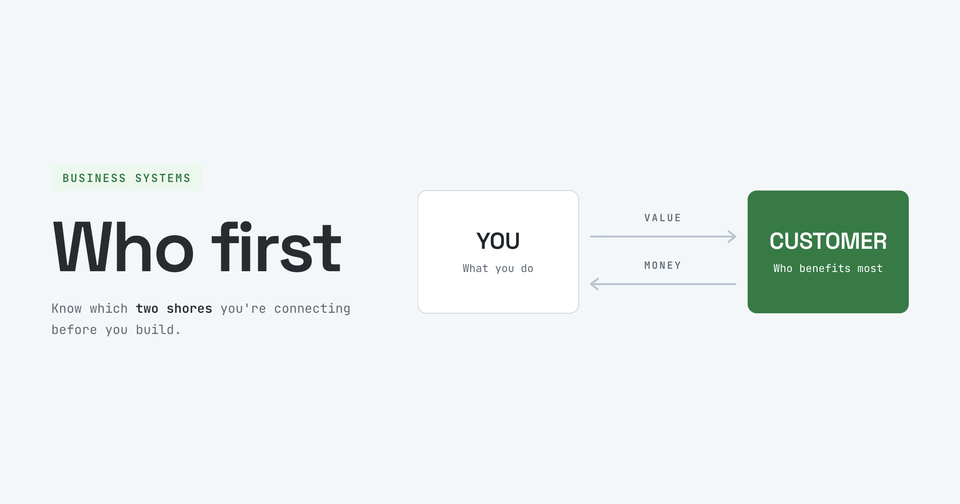
Most founders build the product first and ask who'll buy it later. That's backwards. A business is a value exchange, and the question "value for whom" should come before anything else. This piece walks through why your ideal customer profile (ICP) isn't a marketing afterthought, it's the foundation that shapes your offer, your channels, and your message, and why getting it right makes everything downstream easier.
I remember, whilst working for a corporation long time ago, during one of the 'motivational' training sessions, the trainer asked, "Why are we here?" For the money, someone shouted, not the answer he was looking for. I suppose he was going for a higher purpose, but I didn't buy it.
Any business's main purpose is to make money, which only happens when value is created and exchanged: no value, no exchange, no business. This sounds basic, but it reframes everything that follows by forcing the question "value for whom" right at the start.
Think of a business like a bridge. Value flows one way, money flows the other. If you build the bridge before knowing which two shores you're connecting, you've just built a structure in the middle of nowhere.
Unless they follow the Lean Startup philosophy, many founders spend months perfecting features, refining the offering, obsessing over often unnecessary details, and then ask, "Who's going to buy this?" By that point, you've baked in assumptions about a customer you've never met. The product or service is ready, the marketing is out, the website is polished, yet the phone isn't ringing, and emails aren't coming in. The truth is, what they built isn't wrong; it's just often not built for anyone in particular.
Define your ideal customer profile (ICP): the customer who gets the most value from what you do and who you can reach and serve most efficiently. It's not that demographics, age, location, and business size matter less than situation, problem, and where they spend their attention.
Think long and hard about where your ICP hangs out, maybe they're on LinkedIn, maybe on Facebook, maybe on BlueSky, maybe none of the online places. Basically, where do they go for answers?
Once you know who, you know where. A founder running a Shopify store at three in the morning isn't reading the FT. A senior partner at a law firm isn't scrolling TikTok for accountancy tips. LinkedIn, Instagram, Facebook, podcasts, Reddit, in-person events, referral networks, these are all just rooms your ICP either is or isn't sitting in.
You don't need to be everywhere; you need to be where they are. A solo founder serving UK tech startups probably needs LinkedIn and a couple of well-chosen events. A bookkeeper serving local trades probably needs to join Facebook groups and get Google reviews. Same profession, different ICP, completely different distribution.
Now the offering itself gets shaped by what you've learned. Pricing, packaging, language, and even the service's format all flex around the customer. The same underlying skill, say bookkeeping, looks completely different when packaged for a VC-backed startup founder versus a self-employed plumber. Same value, different wrapper.
This is where it all comes together: ICP informs the offer, the offer informs the channel, the channel informs the message, and the message attracts the ICP. When it's aligned, it compounds. When it's misaligned, every pound spent on marketing leaks.
Write down, in one paragraph, the specific person who would benefit most from what you do. Not "small business owners" but "the founder of a two-year-old SaaS company, doing around £500k ARR, who just hired their first finance person and realises they need proper monthly management accounts." If you can't write that paragraph, you don't have an ICP yet, and everything downstream will be harder than it needs to be.
Lean Ledger supports UK limited company founders who want to do things right from the start. If you need to have a conversation about your ICP, or other aspects of your business,

Luke Raczynski
ACCA-regulated accountant. Lean Ledger prepares limited company accounts for UK founders who'd rather have year end be a 30-minute conversation than a three-week scramble.