How to think about your business's online presence
A practical way to decide what your business actually needs online.

Founder, Lean Ledger Ltd
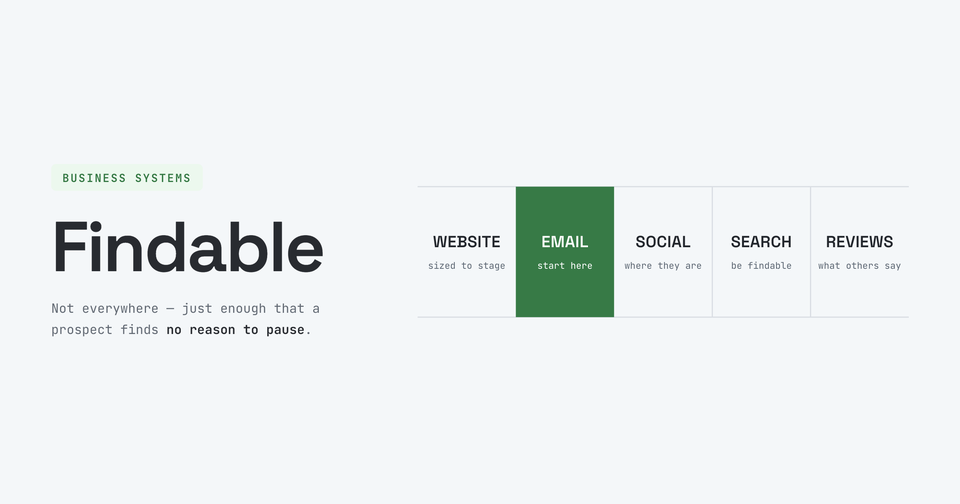
Online presence is not about being everywhere. It is about making sure the people you want to work with can find you and trust what they find.
This guide sits a little outside Lean Ledger's usual territory. It's not about accounting, tax, or compliance. It's about something more fundamental: whether the people you want to work with can actually find you, and whether what they find when they look gives them enough confidence to get in touch.
A pattern shows up often in conversations with founders. The accounts are in order, the company is properly registered, and the work is good. And yet the pipeline is thinner than it should be. When you ask how clients hear about them, the answer is almost always "word of mouth" or "I knew them already". That can work for a while. It can even work for a long time. But it puts a ceiling on the business that most founders would rather not have, and it makes the business uncomfortably dependent on a small handful of relationships.
Online presence is one of the few things every business can invest in, regardless of industry, location, or budget, and the cost of getting it wrong (or not doing it at all) tends to be invisible. You don't see the prospect who searched for your name, didn't find a website, and quietly went elsewhere. You don't see the warm referral who looked you up on LinkedIn, found nothing, and didn't follow through.
This guide is not a checklist of things you must do. It's a way of thinking about the question, so that whatever you decide to invest in, you're investing for the right reasons.
Why do people look you up before they get in touch?
Before someone contacts you, especially for anything more than a transactional purchase, they almost always look you up. They Google your name, check LinkedIn, look for a website, and read reviews. They're not necessarily doing this to evaluate you in detail. They're doing it to confirm that you exist, that you're real, that other people take you seriously, and that engaging with you is unlikely to be a waste of time or, worse, a mistake.
This isn't suspicion, it's prudence. Most professionals do it without thinking. The question is what they find when they look.
If they find a clean, current website and an active professional profile, the prospect's confidence increases, and they take the next step. If they find nothing, or a half-finished site from 2019, or a LinkedIn profile that hasn't been updated since you left your last job, the prospect's confidence drops. They might still get in touch, but they're now starting from a position of doubt that you have to overcome rather than build on.
The bar is not "have an impressive presence". The bar is "give a prospect no reason to pause".
What "online presence" actually covers
It's worth unpacking the term, because people use "online presence" to mean different things. For most small businesses, there are five components, and they each do a different job:
A website is your home base. It's the one thing you fully control, the one place where the message is exactly what you want it to be, and the place a prospect ends up after hearing your name from any other source.
A professional email address on your own domain (for example, hello@yourbusiness.co.uk rather than yourbusiness@gmail.com) is the smallest, cheapest signal you can send that this is a real business. It costs a few pounds a month, and the absence of one is noticed more than its presence.
Social media is where you exist in the feeds of people who don't yet know they need you. Which platforms matter depends entirely on who your customers are. A B2B consultancy probably needs LinkedIn. A craft business probably needs an Instagram or TikTok account. A local trades business probably needs a Facebook page and a Google Business Profile.
Search visibility is whether you turn up when someone Googles either you specifically or the kind of work you do. This breaks down into appearing under your own name (almost always achievable, often neglected) and appearing for the things people search for when they don't know you yet (harder, more strategic).
Reviews and third-party mentions are what other people say about you in places you don't control. Google reviews, Trustpilot, industry directories, podcast appearances, and articles you're quoted in. These are higher-trust signals than anything you say about yourself, which is exactly why they matter.
You don't need all five to be doing the same job. You need to think about which ones matter to your business and your customers, and invest in those.
The honest bit: do you actually need a website?
You'll find a lot of advice online that tells you every business needs a comprehensive, content-rich, SEO-optimised website. Some of that advice is right. Some of it is being given by people who are paid to build websites.
The honest answer is that most businesses do need a website, but the kind of website varies enormously, and "website" is not one thing.
There are broadly three categories.
A digital business card. A single page, or a small handful of pages, that confirms you exist, says what you do, and gives prospects a way to get in touch. This is the right answer if your customers come almost entirely from referrals or in-person networking, and they're looking you up to verify you're real before responding. Goal: don't lose them at the point of due diligence. Investment: small. Returns are mostly defensive (you stop losing prospects) rather than generative (it doesn't bring you new ones).
A trust-builder. A more substantial site that explains what you do in depth, who you do it for, what working with you looks like, and why a prospect should pick you over the alternatives. Often includes case studies, testimonials, an "about" section that introduces you as a person, and clear pricing or service structures. This is the right answer if prospects come from a mix of referrals and other channels, and you want to convert a curious visitor (not just an already-warm lead) into a conversation. Goal: turn interest into enquiry. Investment: meaningful but one-off.
An active marketing engine. A site that publishes regular content (articles, guides, case studies), is optimised to rank in search results for terms your customers actually search and serves as a system for generating leads from people who didn't already know you existed. Goal: bring in a steady flow of prospects who are looking for what you offer but don't yet know you. Investment: substantial, ongoing.
These are stages, not just options. Most businesses start at one and grow into the next. There's no shame in starting with a digital business card if that's what fits your stage. There may be a real cost to skipping straight to "active marketing engine" when you don't yet have the content, time, or strategic clarity to make it work.
A few businesses really don't need a website at all. The plumber whose entire pipeline comes from word of mouth in a tight community, the boutique consultant whose ten clients come from a personal network, the artist who sells exclusively through galleries. If your prospects don't look you up online, and you have a clear and durable reason to believe they never will, you don't need one. Be honest with yourself about whether that's actually true.
What "professional-looking" actually means
You'll often hear that a website needs to "look professional". The phrase is overused and rarely defined. In practice, professional-looking comes down to a small number of things, none of which require a designer with a five-figure budget:
The site loads quickly. Slow sites lose visitors before they've read a word.
The text is clear, easy to read, and free of typos and grammatical errors. The single most damaging thing on a small business website is sloppy writing. It signals carelessness about everything else.
The design is consistent. The same fonts, the same colours, the same tone, on every page.
It works on a phone. The majority of visitors will arrive on mobile devices, and a site that's usable only on desktop is effectively broken for most of its audience.
It says, on the homepage, who you are, what you do, and who you do it for, within a few seconds of someone landing on it. Many small business websites fail this test. Visitors arrive on a vague homepage with marketing copy and have to hunt for the actual answer to "what is this business?".
It makes the next step obvious. If you want enquiries, the contact route should be visible from every page. If you want bookings, the booking system should be one click away.
If a small site does these six things, it looks professional. If a large, expensively-designed site fails any of them, it doesn't.
Email addresses
This is the single highest-leverage thing on the list. A custom email address on your own domain costs around £5-10 per month with a service like Google Workspace or Microsoft 365, takes about thirty minutes to set up if you already have a domain, and signals to prospects that you take your business seriously enough to invest in basic infrastructure.
A Gmail or Hotmail address, by contrast, signals one of two things: either the business is so new it hasn't set this up yet, or it's not really a business at all. Neither is what you want a prospect to be thinking when they email you for a quote.
The cost-benefit calculation here is so heavily skewed in favour of doing it that there is essentially no good argument against. If you don't yet have a domain, register one (your business name plus .co.uk or .com is the obvious starting point) and set up email on it. This is the first thing to do, before the website, before the LinkedIn profile, before anything else.
Social media: where to be, and where not to be
Social media presence is where most small business owners waste the most time, because the default advice is to "be everywhere". You shouldn't be everywhere. You should be where your customers are, and ideally only where you can sustain a presence without it becoming a second job.
Some rough heuristics, allowing for plenty of exceptions:
LinkedIn matters if you sell to other businesses, especially in professional services, B2B software, recruiting, or any other industry where the buyer is a working professional. It also matters disproportionately when you sell anything, because the prospect wants to know who you are as a person before engaging. Founders in B2B tech, professional services, consulting, finance, and senior recruitment generally find LinkedIn worth the investment.
Instagram and TikTok matter for visual products, food, beauty, fashion, design, hospitality, fitness, and anything where what you do photographs or films well, and where the buyer is a consumer.
Facebook still matters for local businesses (trades, restaurants, hairdressers, gyms), older demographics, and community groups. Less relevant for B2B in 2026 than it was a decade ago, but the local-business case remains strong.
X (formerly Twitter) is a niche tool. For people building in tech, in media, or in policy, it can be a meaningful network. For most other businesses, it's a time sink with limited commercial return.
YouTube is unique in that videos posted there can drive traffic and credibility for years after they're posted. Worth considering if you can produce video content reasonably well, even if you can't.
Google Business Profile, technically more of a directory than a social platform, deserves a mention here because, for any business with a physical location or a local service area, it's probably the highest-return ten minutes you can spend online. Setting it up properly means you appear on Google Maps, in local search results, and with reviews, photos, opening hours, and a direct link to your website.
The trap to avoid is starting profiles on every platform "just in case". Inactive or thinly-maintained profiles are worse than not being there at all, because a prospect who finds an abandoned LinkedIn page from three years ago will draw worse conclusions than one who finds nothing.
Pick one or two platforms that genuinely fit your audience, and commit to maintaining a presence there. You can always add more later.
SEO and the question of being found
Search engine optimisation, SEO, is the practice of making your site appear in search results when people Google relevant terms. There is a vast industry built around it, much of which is overcomplicated for small businesses.
For most small businesses, SEO breaks down into two practical questions.
Can people find you when they search for your name? This is the easy part, and the part most businesses get for free. If your business is called "Northern Lights Joinery" and someone Googles those words, you should be the first result. Achieving this requires owning a domain name that includes or relates to your business name, having a website with your business name, and ideally being listed in a few directories. It is rare for a business to fail this test once they have a basic web presence, but it is worth checking.
Can people find you when they search for what you do? This is the harder part. If someone in your area Googles "bespoke fitted wardrobes Manchester", do you appear? This depends on local SEO (Google Business Profile, location signals on your site, reviews), on having content on your site that matches what people search for, and on being timely. Search rankings build slowly. You don't get to page one in a fortnight.
For most small businesses with local or referral-based customer bases, the first question is the one that matters most, and it's largely solved by having a basic website set up properly. The second question matters more if you're trying to grow beyond your current network, and it's a real, sustained piece of work that takes months to pay off.
A note on what's now being called GEO (generative engine optimisation), which is the equivalent question for AI search tools like ChatGPT, Perplexity, and Google's AI overviews. As of 2026, a meaningful and growing share of search traffic now flows through these tools rather than traditional search engines. The early evidence suggests that the same things that help you with traditional SEO also help here: clear, well-structured content on your own site, mentions in third-party sources the AI models have been trained on, and accurate business information in directories. This is an evolving area worth keeping an eye on, but for now, the right response is the same as what already works for traditional search: produce clear, honest, useful content on your own domain.
Keeping content current, or deliberately not
A common failure mode for small business websites is the blog that starts strong, posts twice a week for a month, and then sits untouched for three years with the most recent post dated "March 2022". This is worse than no blog at all. A prospect landing on it concludes that the business has either stopped operating or stopped caring.
The right response to this is one of two choices, depending on your stage and your appetite.
If you want an active content presence, commit to a sustainable cadence. One post a month that you actually publish is far better than four a week that you intend to publish. Consistency beats volume. The content doesn't have to be original research or revelatory thinking. It can be answers to client questions, explanations of common problems, and walkthroughs of what you do.
If you don't want an active content presence, don't have a blog. Treat the website as a digital business card or a trust-builder, with content that doesn't date (what you do, who you do it for, how to get in touch, who you are). There is no obligation to publish. A small, current site is far better than a large, stale one.
The question is not "should I have a blog?" The question is, "Am I prepared to maintain one?" If the answer is no, that's a perfectly legitimate decision.
Reviews and reputation
Reviews matter more than most small business owners realise, and they matter most in industries where the buyer feels exposed: tradespeople in someone's home, financial professionals handling someone's money, anyone working with vulnerable clients, and anyone where the cost of a bad provider is high.
Two practical points.
First, the absence of reviews is itself a signal. A business with no Google reviews looks newer, smaller, or less established than one with 20. That's not always a fair conclusion, but it's the conclusion prospects draw. Asking happy clients to leave a review, sometimes around the moment they tell you they're pleased with your work, is one of the highest-return things you can do, and most businesses simply don't ask.
Second, reviews are not just about the count. A business with eight five-star reviews from happy named clients with realistic-sounding stories is more credible than a business with fifty reviews that all sound the same and appeared in the same week.
Authenticity reads. Don't fake it.
When to invest, and when to wait
Online presence is an investment. Like any investment, the question is not "should I" but "should I now, and at what level?".
A few useful guidelines:
If you don't have a custom email address, fix that this week. It's the cheapest, highest-return thing you can do.
If you don't have a website at all, and your prospects are likely to look you up, build at least a digital business card. It does not need to be elaborate.
If you have an outdated website that contradicts your current positioning, prioritise either updating it or replacing it with something simpler. A good, simple site beats a bad, complex one every time.
If you don't have time to maintain an active social media presence, pick one platform where your customers are and commit to a modest, sustainable rhythm. If you can't do even that, don't pretend you can; an empty profile is worse than no profile.
If your business depends on local search (people who come to you or go to you in person), set up your Google Business Profile properly. This is high-leverage and underused.
If your business is at a stage where new client acquisition is the binding constraint and you're not getting enough inbound interest, think harder about content, SEO, and active platforms. If your business is at a stage where you've got enough work and the constraint is delivery capacity, none of the active marketing investments is urgent.
The mistake is to invest based on what appears to be an industry standard, rather than on what actually fits your business and stage. A founder running a £200k turnover service business does not need the same online presence as a venture-backed startup with a content marketing team. Pretending otherwise is how marketing budgets get burned without commensurate return.
The Lean Ledger view
Lean Ledger is an accountancy practice, so why a piece on online presence? Because the consequence of getting it wrong and getting it right shows up in clients' numbers. Businesses that invest thoughtfully in online presence have more predictable pipelines, less concentration risk, and more pricing power. Businesses that rely entirely on referrals are more profitable per client (no acquisition cost) but more fragile per relationship.
The practice doesn't build websites or run social media campaigns. But it does think about businesses as systems, and online presence is one of the systems that determines whether a business has a future as well as a present. If you'd like to talk through how this connects to your wider business decisions, financial planning, growth strategy, hiring, and pricing, get in touch. The aim is to help you think about it clearly, without selling you anything you don't need.

Luke Raczynski
ACCA-regulated accountant. Lean Ledger prepares limited company accounts for UK founders who'd rather have year end be a 30-minute conversation than a three-week scramble.