Who is responsible (for your company)?

Founder, Lean Ledger Ltd
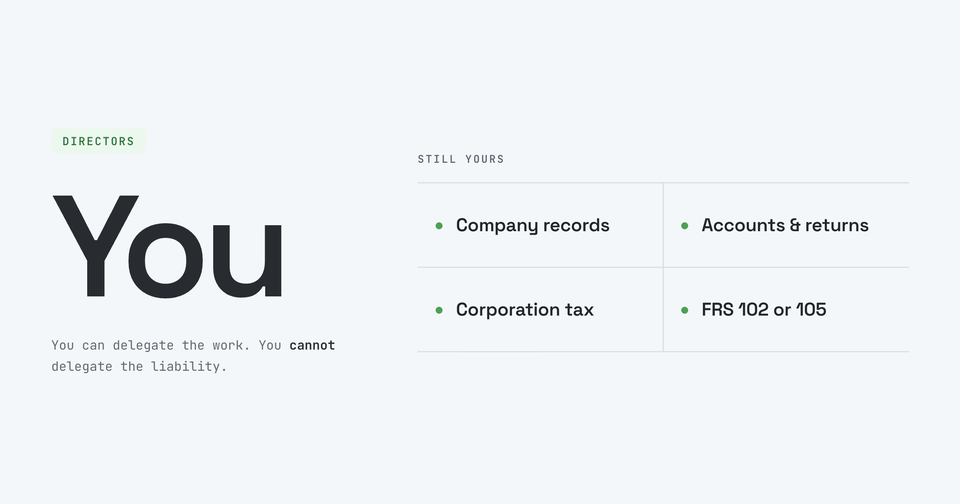
Delegating work doesn't remove your legal responsibility as a director. Use a qualified accountant with a practising certificate.
Short answer: You
Long answer: Well, still you. I came across the notion among some businesspeople that, once you delegate or subcontract work, you cease to be responsible for that part of the business. If something goes wrong, you will pinpoint the one who made the mistake, and that’s it. Well, it is not valid. As a company director, you are legally responsible for your business. The implication is that you should only engage with people you trust who can perform well in the task for which you hired them. Suppose you or someone you hired messes up the graphic design of your website. In that case, you ‘only’ risk going viral (for all the wrong reasons) and possibly losing some income and goodwill. However, you will get a fine if you file your accounts late. There can also be other ramifications if the accounts are not adequately prepared.
Among other things, as a director, you are responsible for:
- keeping company records
- filing accounts and tax returns (whether the business is operating or not)
- paying Corporation Tax
Unless you know how to prepare accounts according to the required standard (FRS102 or FRS105) and then file them with the Companies House and HMRC, you will need an accountant to do it for you.
How would you know if the one you plan to engage is good? A good rule of thumb is that the accountant should be a member of one of the leading accountancy bodies (ICAEW, ACCA, and CIMA, among others, slightly smaller in the UK). If they are, you can be sure that they went through a process of passing challenging exams and gaining at least three years of relevant experience under supervision. They need to keep their knowledge up to date. (One side note: Only qualified accountants can sign the accountant’s certificate required by some banks when you apply for a loan or mortgage.)
Additionally, they must hold a practising certificate to operate independently. This information is public, so you can check whether your prospective accountant is a member on the organisation’s website.
But is this enough? Well, not necessarily; even qualified accountants can be out of practice if they haven’t worked as accountants for the past few years. Or you may have heard the ‘qualified by experience’; I’m sure many have perfectly valid reasons for not passing the exams organised by the accounting bodies, and they have the appropriate experience to prepare the accounts. The only problem I see here is how you would check the accuracy of their claims. Anyone can call themselves an accountant, but as I wrote at the beginning, you are responsible for your business.
Yours truly
(fully qualified accountant, member of ACCA and AAT and practising certificate holder, in case you wondered)

Luke Raczynski
ACCA-regulated accountant. Lean Ledger prepares limited company accounts for UK founders who'd rather have year end be a 30-minute conversation than a three-week scramble.