Your Company Is Not Your Business
The legal structure is not the business itself.

Founder, Lean Ledger Ltd
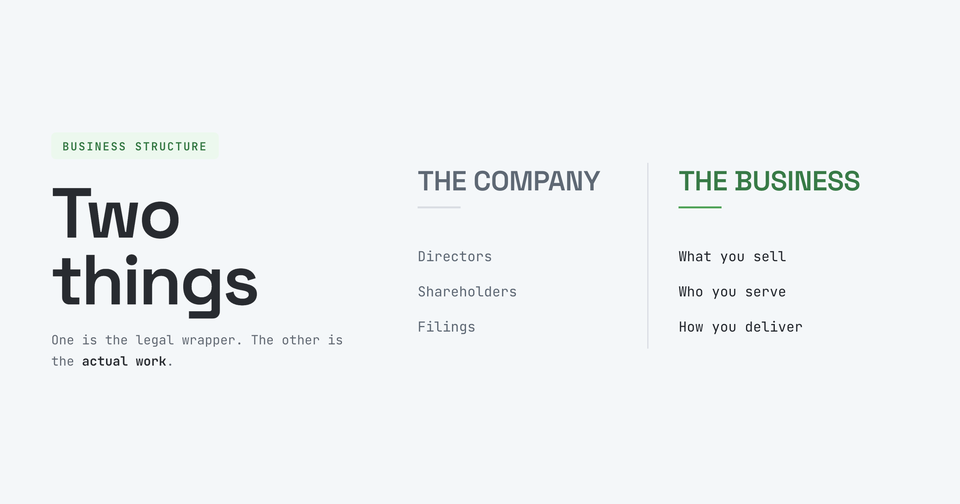
A company is only the legal setup. The business is what you sell, who you serve, and how you deliver it.
Many new founders get confused about this, which often leads to poor decisions early on.
People often mix up the terms "company" and "business," but they mean different things. Your business is what you actually do - what you sell, who you sell it to, and how you deliver it. Your company is just the legal setup you use to run that business, with directors, shareholders, and legal responsibilities.
A successful business can exist without a company, and a company can exist without a thriving business. These are separate concepts.
This is important because UK founders are usually told to set up a company right away, often before they know if their business idea works. By 2026, the costs and benefits of running a UK limited company have changed enough that this advice is often wrong, especially for service businesses.
What's changed
Several changes have all made things harder for limited companies:
In April 2026, dividend tax rates will go up (basic rate from 8.75% to 10.75%, higher rate from 33.75% to 35.75%). This reduces the tax benefit of paying yourself with a mix of salary and dividends. With the £500 dividend allowance and frozen personal allowance, the tax difference between sole traders and limited companies is now smaller than it has been in years.
From April 2025, Employer National Insurance increased to 15% on earnings over £5,000, and the threshold dropped from £9,100 to £5,000. If you're a director paying yourself a salary at the personal allowance, this is an extra cost that limited companies didn't face before.
Companies House fees increased significantly in May 2024 and will rise again in 2026. When you add in the need for Making Tax Digital (MTD)-compatible accounting software, higher accountancy fees for preparing statutory accounts and corporation tax returns, and the cost of running payroll, the total administrative costs for a limited company now include multiple compulsory filings, additional software subscriptions, and more professional fees than before.
For a typical service business making £40,000 to £70,000 in profit, take-home pay is now almost the same whether you operate as a limited company or a sole trader, but a limited company involves much more admin.
Why start a sole trader
If you run a service business, especially in your first year or two, being a sole trader has some real benefits:
You can test your business idea without any legal commitments. If it doesn't work out, you just stop trading. There's no need to wind up a company, file final accounts, deal with Companies House, or pay extra fees to close things down.
Your admin is much simpler. As a sole trader, you only need to do one Self Assessment return each year. You avoid the extra admin that comes with a limited company, such as preparing statutory accounts, filing corporation tax returns, submitting confirmation statements, handling payroll, and keeping dividend records. This allows you to focus on running your business without the extra administrative steps required of a company.
Your accounting fees are lower. Your accounting costs are lower. A sole trader's yearly accounts and Self Assessment are much cheaper than those for a limited company, which also needs a CT600. That means you can spend more on your business instead of on admin. What the business actually needs before you commit to a structure that's harder to unwind. Many founders incorporate based on assumptions about future scale, hiring, or investment that turn out to be wrong. The structure outlives the assumption, and the founder is stuck with the admin.
When to incorporate
Some founders should set up a company right from the start. The choice between sole trader and limited company isn't the same for everyone, and sometimes a limited company is the best option:
If you're working in a field with real risks, like construction, regulated professional services, or anywhere customers could claim big damages, then the protection of a limited company is worth the extra admin from the start.
If you want to raise investment, you need to be a limited company. Investors take equity, and you can't offer shares as a sole trader.
If you're landing contracts that require you to be a limited company, some big clients won't work with sole traders, then you should incorporate to get those deals.
If you want to bring in a co-founder, you'll need a setup that allows for shared ownership.
If your profits are well over £100,000 and you don't need to take all of it out to live on, so you can leave money in the company or pay into a pension, the tax benefits of a limited company start to make sense again.
For most service businesses that don't fit these situations, it's usually smarter to start as a sole trader and only set up a company once your business is working. You can incorporate later and use incorporation relief to delay paying capital gains on any goodwill you transfer. The business should come first, and the structure should follow.
The decision framework
When founders ask me if they should incorporate, I usually ask them what's really motivating the decision.
If it's about tax, do the math for your expected profit. The answer is often not what people think.
If it's liability, If it's because of liability, that's a good reason to set up a company.n, that's also legitimate, but worth checking whether your specific customers actually care.
If your only reason is that "everyone does it," that's not enough. Many successful businesses stay as sole traders for years, and some never incorporate.
Pick the structure that fits your business. Having a limited company doesn't make you more serious, and being a sole trader doesn't make you less professional. The structure is just a tool, choose the one that works for you.
I've shared a full decision checklist on the Lean Ledger site, including an example for a £60,000 profit using the 2026/27 rates. It covers the five key factors, liability, perception, tax, admin, and exit strategy, in the order you should think about them.
Before setting up a company, spend an hour on the checklist. This decision deserves careful thought.

Luke Raczynski
ACCA-regulated accountant. Lean Ledger prepares limited company accounts for UK founders who'd rather have year end be a 30-minute conversation than a three-week scramble.