Organised vs Chaos
The practical habits that keep founder-led companies out of firefighting mode.

Founder, Lean Ledger
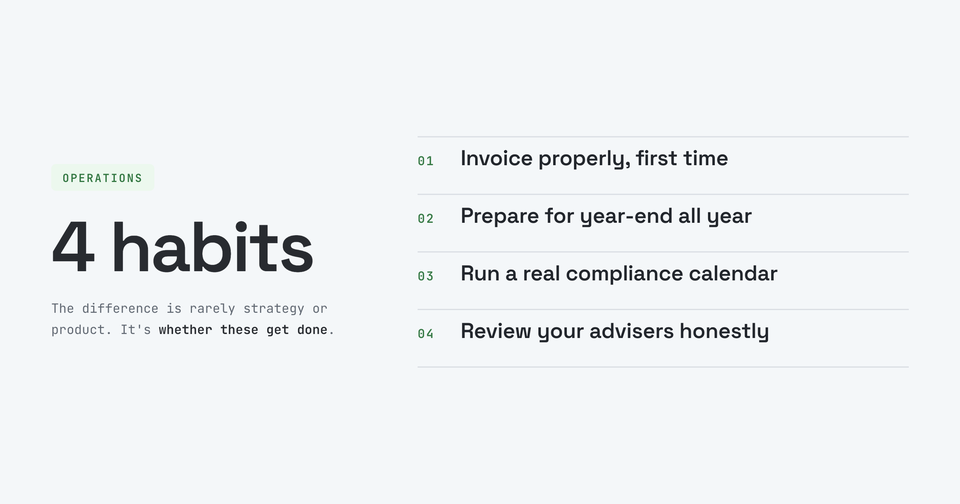
Organised companies usually do the unglamorous work consistently: compliant invoices, year-end preparation, deadline reminders and honest adviser reviews.
A clear pattern separates thriving businesses from those constantly firefighting. The difference is rarely strategy, product, or cash flow. Instead, organised companies consistently follow a set of operational disciplines, while chaotic ones address them only when problems arise.
I have just published practical resources on the Lean Ledger website: an invoice checklist, a year-end information pack, a guide to switching accountants, and an annual compliance calendar.
What the organised companies do differently
If I had to summarise it, they do four things consistently:
1. They invoice the first time properly.
Most founders handle invoicing well, but common errors such as missing company numbers, vague descriptions, non-sequential numbering, and incorrect VAT treatment cause payment delays, disputes, and HMRC issues. Organised companies create a compliant template once and use it consistently. Chaotic companies frequently change their invoices and experience slow payments.
2. They prepare for year-end throughout the year, not in the last month before the deadline.
Year-end accounts should not be a stressful event. Ideally, they prompt a brief discussion about the year ahead. The difference lies in whether the founder maintains records throughout the year or scrambles to reconstruct months of activity at the last minute.
3. They run a real compliance calendar.
A typical UK limited company faces about 20 statutory deadlines each year, plus monthly RTI payroll submissions. Organised companies set up a compliance calendar with 30-day reminders. If you are not organised, it is easy to miss deadlines and respond only after receiving late-filing notices.
4. They review their professional relationships honestly.
Many founders avoid reviewing their advisers. Accountants, lawyers, brokers, and other professionals should justify their fees each year. If they do not, switching is a standard business decision. Organised founders review these relationships annually and make changes as needed. Chaotic founders often remain out of inertia or guilt, resulting in subpar advice.
Why these four, specifically?
Because they're the leading indicators of how a company is actually being run.
A founder who can quickly produce a compliant invoice, provide a complete year-end pack, list compliance deadlines, and recall their last adviser review is likely managing other aspects of the business well. Conversely, poor invoicing often reflects broader organisational issues.
None of these practices requires specialist knowledge, expensive software, or qualifications. The key difference is whether the founder has established systems or repeatedly addresses the same issues as they arise.
Where to start
If you are considering improvements, I recommend the following order:
- Start by improving invoicing. It offers the greatest impact and is the simplest to address. Investing a few hours in creating a template provides lasting benefits.
- Next, create a compliance calendar with reminders set 30 days before each deadline. This approach removes uncertainty and ensures deadlines are met.
- Prepare the year-end pack in advance. Providing a complete pack at the start of the year-end allows your accountant to focus on offering advice rather than requesting missing documents.
- Review your advisers annually. If they are not providing sufficient value, switching is straightforward.
Checklists for each of these steps are available on the Lean Ledger resources page. They are free, require no email signup, and are designed for founders who prefer to focus on growing their business.
These operational disciplines may seem unremarkable, but they are well worth your time. Organised companies consistently apply them, while chaotic companies struggle without them.
Lean Ledger supports UK limited company founders who prefer to automate routine tasks rather than manage them manually each quarter. If this approach aligns with your needs, book a discovery call →

Luke Raczynski
ACCA-regulated accountant. Lean Ledger prepares limited company accounts for UK founders who'd rather have year end be a 30-minute conversation than a three-week scramble.