Director's Loan Account (DLA) Guide
The Director's Loan Account Guide: Three Charges Directors Often Miss

Founder, Lean Ledger Ltd
Executive summary A director’s loan account records intra-company money transfers, excluding salary, dividends, or reimbursed costs. An overdrawn balance triggers a section 455 tax charge under the Corporation Tax Act 2010, assessed nine months and one day after the accounting period closes. The rate is 35.75% for loans on or after 6 April 2026, and 33.75% for loans between 6 April 2022 and 5 April 2026. The charge is due before the accounts filing deadline, not the submission date, and is refundable if repaid, though repayment extends liability. A 3.75% benefit-in-kind applies if the overdraft exceeds £10,000. Lending requires a members’ resolution for amounts over £10,000, documented under section 197. No corporation tax deduction applies, and section 455 tax is delayed.
Most limited company directors have a director’s loan account whether they know it or not. It is simply the running tab between you and your company: money that has moved in either direction that isn't salary, a dividend, or a reimbursed business expense.
The problem is that the tab is invisible until someone adds it up, usually your accountant, usually months after the year-end, usually when there is nothing left to do about it. By then, the balance has a tax charge attached to it and a deadline that has already passed.
Let me explain what this account is and how to handle it effectively.
What sits in the account
Think of your company as a separate person who happens to share a bank account history with you. Every time money crosses between the two of you without a proper label, it goes on the tab.
Typical entries on the overdrawn side:
- Cash transfers from the business account to your personal account with no dividend paperwork behind them
- Personal spending on the company card, the weekly shop, a family holiday, a personal phone contract
- Dividends taken in anticipation of profits that never arrived
- Your own tax bill paid from company funds.
- Typical entries on the credit side:
- Money you put in to start the company or to cover a cash flow gap.
- Business expenses you paid personally and have not yet reclaimed
- Salary or dividends declared but not physically withdrawn.
If the balance leans your way, the company owes you, and there is nothing to worry about. If the balance leans the company’s way, the account is overdrawn, and that is where the tax lands.
Crediting the account counts as a payment to you.
A common misunderstanding is that nothing happens for tax until the cash physically moves. It is the other way round. A credit to your loan account is treated as a payment to you at the moment it is made.
A dividend voted in December and left sitting in the account is taxed as a dividend in that tax year, whether or not you touch the money. Earnings voted and credited rather than paid have to go through payroll at the date of the credit, with PAYE and Class 1 National Insurance deducted then, and only the net figure credited to the account.
The principle comes from Garforth v Newsmith Stainless Ltd (1978): a payment of earnings happens when the money is put unconditionally at your disposal, regardless of whether it physically moves and regardless of which period it relates to. The tribunal in Ventura UK Ltd (2017) applied that to a director’s loan account which was permanently in credit because the director had lent the company a large sum. Amounts credited to the account but never drawn were still earnings carrying PAYE and National Insurance, and a prior year adjustment in the accounts did not undo the liability. You cannot fix this sort of thing retrospectively in the bookkeeping.
That is exactly why drawing down a credit balance later costs you nothing. You are taking out money that has already been taxed and that the company already owed you.
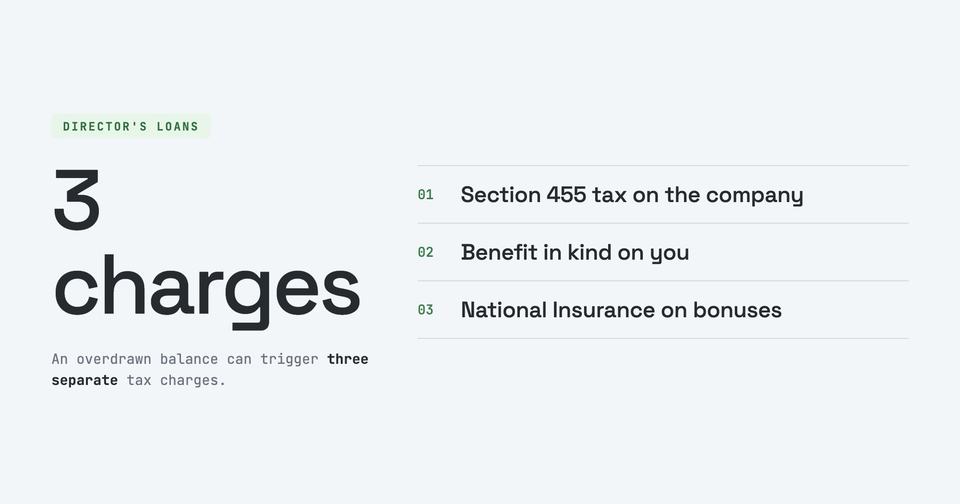
Charge one: section 455 tax on the company.
Most owner-managed companies are “close companies”, broadly a company controlled by five or fewer shareholders. If a close company lends money to a shareholder or director and the loan is still outstanding nine months and one day after the end of the accounting period, the company pays a tax charge on the outstanding balance under section 455 of the Corporation Tax Act 2010.
Two points that catch people out.
The rate went up in April 2026. Section 455 is pinned to the dividend upper rate, so when the Autumn Budget 2025 raised that rate, the loan charge moved with it. The rate is now 35.75% for loans made on or after 6 April 2026, and it stays at 33.75% for loans made between 6 April 2022 and 5 April 2026. What matters is the date the money was drawn, not your year-end date, so a company can easily be sitting on two tranches at two different rates.
It is your corporation tax deadline, not your filing deadline. Nine months and one day after the year-end is the date the money is due, which is roughly three months before the accounts have to be filed. Many directors discover the charge after the payment window has closed.
An illustration
Let’s imagine George, a director and owner of GeorgeCo Ltd, a pet grooming service company. During the accounting year running up to December 2026, he draws £40,000 from the business account beyond his salary and declared dividends. At 31 December 2026, the loan account is overdrawn by £40,000.
He does not pay it back. On 1 October 2027, the company owes HMRC £14,300 in section 455 tax, that is £40,000 at 35.75%, on top of its ordinary corporation tax.
The charge is refundable, which sounds reassuring until you look at the timing. If George repays the loan in March 2028, that repayment falls in the accounting period ending 31 December 2028, so the section 455 tax comes back nine months and one day after that period ends, on 1 October 2029. The company is out of pocket for two years, and the claim is not automatic: you make it on form L2P, and there is a four-year time limit from the end of the accounting period in which the loan was repaid.
Charge two: benefit in kind on you personally.
Section 455 is a company charge. There is a separate personal one.
If your overdrawn balance exceeds £10,000 at any point in the tax year and the company charges you either no interest or interest below HMRC’s official rate, the difference is a taxable benefit in kind on you. The official rate is 3.75% for 2026/27, unchanged from 2025/26 but sharply up from the 2.25% that applied until April 2025.
On an average balance of £25,000, the benefit is £937.50. A higher-rate taxpayer pays £375 in income tax on that, and the company pays Class 1A National Insurance at 15%, another £140.63. It is not a huge sum, but it must be reported on a P11D by 6 July after the tax year, with Class 1A paid by 19 July, or 22 July if paying electronically. If you miss the return, penalties are per employee per month.
One detail worth knowing: when payrolling of benefits becomes mandatory from April 2027, employment-related loans are one of only two categories staying outside the new regime. Beneficial loans and living accommodation continue on the P11D. If your accountant tells you the P11D is going away entirely, they haven't read the details.
You can avoid the benefit charge by having the company charge you interest at 3.75% or more. That interest is then taxable income in the company, so it is a swap rather than a saving, but for a large balance it is often the cheaper swap.
Charge three: National Insurance, if you clear the account with a bonus
Section 455 and the benefit in kind are the two charges everyone writes about. There is a third, and it depends less on the size of your balance than on your habits.
For National Insurance purposes, HMRC looks at how you normally clear the overdrawn balance.
- If you habitually clear it by voting dividends, HMRC treats the overdraft as a loan. No Class 1 National Insurance arises, although Class 1A may be due on the beneficial loan as above.
- If you habitually clear it by voting salary, fees or a bonus, the withdrawals are treated as an advance of those earnings. An advance of earnings to a director is earnings at the moment it is paid, so Class 1 National Insurance, employee and employer, is due then, not at the meeting where the bonus is finally voted.
Two directors with identical £40,000 balances can therefore be in completely different positions. The one who clears with dividends has a loan and a section 455 exposure. The one who clears with a bonus every December has, in HMRC’s view, been paid earnings throughout the year without PAYE being operated on them, which brings unpaid Class 1 contributions, interest and penalty exposure into the picture.
Why the pattern is what matters
The rule only bites where the drawing is an advance on account of earnings. If your company regularly clears the account by voting dividends, or by writing off balances that are then taxed as distributions, this legislation simply does not apply to you.
It also depends on the drawing being authorised. Money taken without authority cannot be earnings, because you were never unconditionally entitled to it, and there are worse problems attached to that. HMRC treats advance drawings as authorised where the other directors have approved them in writing or verbally, or where it has become custom and practice, so the approval is clear even though nobody says it out loud. In a family company where everyone knows the director draws as they go and squares up at year-end, that implicit approval is exactly what HMRC will point to.
What this means in practice
If earnings are your normal clearing route, the drawings should go through payroll as they are taken, not once a year when the bonus is voted. Real Time Information requires a submission on or before the date of every payment of earnings, which is an awkward fit for a director who takes irregular amounts as cash flow allows, but it is the requirement.
The good news is that there is no double charge. When earnings are later voted to clear the account, they are disregarded to the extent Class 1 has already been accounted for on the drawings.
Note the contrast with your staff. An advance of pay to an employee who is not a director is not earnings until they are unreservedly entitled to the money. Directors get the stricter treatment.
The rule is in regulation 22(2) of the Social Security (Contributions) Regulations 2001, with HMRC’s guidance at NIM12014. If your routine is to draw as you go and settle up with a bonus at the year-end, this is worth reviewing before the next drawing, not after.
Why repaying just before the deadline does not work
The obvious move is to repay a week before the nine-month deadline and take it out again a week later. HMRC closed that door in 2013, and two rules apply.
The 30-day rule. If you repay £5,000 or more and within 30 days either side you take a new loan of £5,000 or more, the repayment is matched against the new loan instead of the old one. The original balance is treated as still outstanding, and section 455 applies.
The arrangements rule. Where the balance is at least £15,000 before the repayment and, at the time you repay, there are arrangements in place to borrow at least £5,000 again, the same matching applies even if you wait longer than 30 days. This one is a backstop with no fixed time limit, and it turns on intention.
Repayments funded by a properly declared dividend, a bonus or genuine new money from outside are not caught. Circular movements of the same cash are.
The four ways to clear an overdrawn balance
Repay it in cash. Clean, and the only route with no further tax cost. It requires personal funds.
Declare a dividend. The dividend is credited to the loan account, and the balance falls. This works only if the company has sufficient distributable reserves, meaning accumulated realised profits after tax, not the cash sitting in the bank. Without reserves, the dividend is unlawful, the balance stays a loan, and you add a company law problem to your tax problem. You will pay dividend tax at 10.75%, 35.75% or 39.35% depending on your band.
Vote a bonus. Effective, and expensive: PAYE at your marginal rate, employee National Insurance, employer National Insurance on top. It is usually the last resort, though it does at least earn a corporation tax deduction, which a dividend does not. If this is already your habitual route, read the National Insurance section above first, because the Class 1 charge may have arisen when you drew the money rather than when the bonus is voted.
Write it off. The one that looks easiest and rarely is. For income tax, you are treated as receiving a distribution and taxed at dividend rates. For National Insurance, HMRC’s position is that the write-off is earnings, so Class 1 contributions can be due from both you and the company, which is the mismatch that surprises people. The company gets no corporation tax deduction for the amount written off, and any section 455 tax already paid only comes back on the usual nine-month-and-one-day delay. There is an argument that a waiver agreed by the shareholders, in your capacity as shareholder rather than employee, escapes the National Insurance charge. Still, it is a technical position that needs proper documentation before, not after, the event.
The parts that are not about tax
Your loan account is public. Advances and credits to directors must be disclosed in the notes to the accounts under section 413 of the Companies Act 2006, including the amount, the interest rate, and the terms. Those accounts go on the public register at Companies House. Anyone doing due diligence on you- a lender, a landlord, an acquirer- can see it.
Large loans need shareholder approval. Under section 197 of the Companies Act 2006, a company generally cannot lend to a director without a members’ resolution. There is an exception for loans up to £10,000 in aggregate. In a single-director, single-shareholder company, this is a formality, but it should be minuted.
Insolvency removes the safety net. Limited liability protects you from the company’s debts. It does not protect you from your own. An overdrawn loan account is an asset of the company, and a liquidator will pursue it personally, along with a look at whether the withdrawals amounted to a breach of your duties as director.
What good looks like
- Check the balance quarterly, not annually. A number you see in March is a problem you can still solve.
- Set a realistic salary and dividend schedule at the start of the year and stick to it, so drawings have a label before they leave the account.
- Keep a genuinely separate personal card. Most overdrawn accounts are built from small personal purchases, not one big withdrawal.
- Before the year-end, look at reserves and cash together and decide deliberately: repay, declare, or accept the charge.
- If two different section 455 rates apply to your balance, agree with your accountant how repayments are allocated and document it at the time.
- If earnings are your clearing route, pay the drawings as you take them rather than waiting for the year-end resolution.
- Minute remuneration decisions properly. If your company uses the Companies Act 2006 model articles, directors’ remuneration is set by board resolution, so the annual general meeting no longer carries the significance it did under the older articles.
Frequently asked questions
Is a director’s loan illegal?
No. Lending money to a director is permitted, subject to shareholder approval for amounts over £10,000 in aggregate. What is regulated is the tax treatment and the disclosure, not the loan itself.
How much can I borrow from my company?
There is no statutory cap. Practically, above £10,000 you trigger the benefit-in-kind rules and need a members’ resolution, and any balance still outstanding nine months and one day after the year-end attracts section 455 tax.
Can I take a director’s loan instead of a dividend to save tax?
Only for a short period. Deliberately using the loan account as a substitute for taxed drawings produces a section 455 charge at 35.75%, a benefit in kind, and a balance that eventually has to be cleared with taxed income anyway.
Do I have to declare a director’s loan on my tax return?
The loan itself is not taxable income. The benefit in kind on a balance over £10,000 is reportable, and a loan that is written off or released must be declared as a distribution on your Self Assessment return.
I draw as I go and clear the account with a bonus each year. Is that a problem?
Potentially, yes. Where the established practice is to clear an overdrawn account by voting earnings, HMRC treats the drawings as advances of those earnings, so Class 1 National Insurance is due at the time of each drawing rather than when the bonus is voted. The fix is to run the drawings through payroll as they are taken. Clearing the account with dividends instead takes you outside the rule altogether.
Can I just write the loan off?
You can, but it is treated as a distribution for income tax and as earnings for National Insurance, with no corporation tax deduction for the company. It is often the most expensive of the available routes rather than the cheapest.
Where this leaves you
If you are reading this because you suspect your loan account is overdrawn and nobody has mentioned it, the useful question is not how much you owe but how long you have. The section 455 deadline is nine months and one day after your year-end, and the options narrow sharply once it passes.
[CTA: book a discovery call / Year End Information Pack]
Sources
- HMRC, Rates and allowances: beneficial loan arrangements, official rates: https://www.gov.uk/government/publications/rates-and-allowances-beneficial-loan-arrangements-hmrc-official-rates
- HMRC Company Taxation Manual CTM61635, arrangements rule: https://gov.uk/hmrc-internal-manuals/company-taxation-manual/ctm61635
- GOV.UK, Director’s loans (add link)
- Corporation Tax Act 2010, Part 10 Chapter 3, sections 455, 458, 464C and 464ZA (add legislation.gov.uk links)
- Companies Act 2006, sections 197 and 413
- Corporation Tax Act 2009, section 321A, no deduction for amounts written off
- Social Security (Contributions) Regulations 2001 (SI 2001/1004), regulation 22(2)
- HMRC National Insurance Manual NIM12014, advances of earnings to directors
- Garforth v Newsmith Stainless Ltd (1978) 52 TC 522, payment of earnings
- Ventura UK Ltd [2017] TC 06028, amounts credited to a loan account as earnings
- Companies Act 2006 model articles, article 19, directors’ remuneration by board resolution
- Croner-i, ¶1022-750 Earnings advanced or voted, and ¶12175 Director’s loan accounts.
- ACCA, Tax implications of written off overdrawn directors’ loans

Luke Raczynski
ACCA-regulated accountant. Lean Ledger prepares limited company accounts for UK founders who'd rather have year end be a 30-minute conversation than a three-week scramble.