ACCA-Regulated vs Unregulated Accountants: What It Means
"Accountant" is not a protected title in the UK. Here is what ACCA regulation actually adds on top of it.

Founder, Lean Ledger Ltd
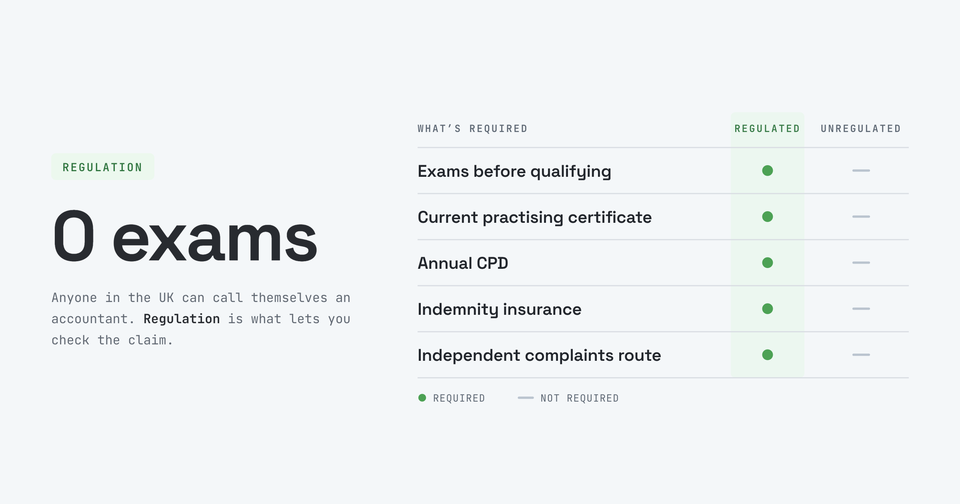
Anyone in the UK can call themselves an accountant with no exam and no regulator. This article explains, factually and without naming names, what ACCA regulation actually requires and guarantees.
Here is a fact that surprises a lot of business owners. In the UK, the word "accountant" is not a protected title. Unlike "solicitor" or "doctor", anyone can call themselves an accountant. No exam is required, no licence, and no regulator. They can still legally offer accounting services to the public. This is not a criticism of any individual. It is simply how the law is written, and it is worth understanding before you hire anyone.
This article explains what that fact means, what ACCA regulation adds on top of it, and how to check whether the person you are talking to is regulated at all.
Why "accountant" is not a protected title
Titles like "chartered accountant" and "chartered certified accountant" are protected. They belong to named professional bodies, each with rules to join and rules to stay in. But the plain word "accountant" on its own carries no such protection. Someone can set up a practice, take on clients, prepare accounts and file tax returns. They can do all of this without ever sitting a professional exam or joining a regulator.
Many people who use the plain title are very good at the job, often with years of real experience behind them. That is worth saying clearly. This article is not about honesty or skill. It is about what options you have if something goes wrong. It is also about the difference between trusting someone and being able to check that trust yourself.
What ACCA regulation actually requires
The Association of Chartered Certified Accountants, or ACCA, is a UK accountancy body. Like other such bodies, it sets exams and standards for its members. Members must pass a set of exams before they qualify. Staying qualified is not a one-off event either. Members must also meet ongoing rules to keep practising.
A firm that offers accountancy services under ACCA needs to be ACCA-registered, and the individual member doing the work needs their own practising certificate. ACCA can check both, and can withdraw either, if standards are not met. Members must also complete continuing professional development each year, often shortened to CPD. This keeps their knowledge current as tax rules and accounting standards change. Their skills do not stay frozen at the point they first qualified.
Professional indemnity insurance, or PII, is another requirement. This means the firm carries insurance that can pay out once a claim of negligence is proven. That is different from a client having to rely only on the firm's own money if a claim succeeds. ACCA firms are also checked for anti-money laundering purposes. That adds another layer of checks on how the practice is run.
What happens if something goes wrong
This is where the practical difference becomes clear. If you have a serious concern about the standard of work from an ACCA member, there is a formal complaints process you can use, run apart from the firm itself. It looks at the member's conduct and can impose real sanctions, up to removing their right to practise. It does not pay you money back or order a refund. Its job is to judge conduct, not to settle your loss.
With an unregulated accountant, no such formal path exists in the same way. Your options are usually limited to a civil claim through the courts. That route tends to be slower and costs more than a regulator's complaints process, if it is even open to you at all. Neither path promises you get everything back. But only one of them starts with a clear, independent process you can actually use.
What ACCA regulation does not guarantee
It is worth being clear here, since regulation is sometimes talked up as more than it is. ACCA membership does not guarantee a member never makes a mistake. It does not promise an outcome you personally like, such as a certain tax result. What it guarantees is a system. There is a minimum standard of qualification, a duty to keep learning, required insurance, and somewhere to go if things go wrong. That is a real difference, and it matters, but it is a difference in process and protection, not a promise of perfection.
Equally, the absence of ACCA regulation does not always mean poor work. Plenty of unregulated accountants do a fine job for their clients, year after year. What is missing is the system around that work. There is no required ongoing training, no required insurance, and no independent complaints route if something does go wrong later.
How to check if an accountant is regulated
Checking is simple. ACCA keeps a public register of its members and firms. You can look up a name yourself, rather than taking a claim on trust. You can also just ask, directly and early: "Are you ACCA-regulated, and do you hold a current practising certificate?" A regulated accountant will answer this clearly and quickly, since it is public information about their own status.
If someone is vague about the question, or the answer seems to shift depending on how it is asked, treat that as useful information on its own. It costs nothing to ask, and the answer tells you something real about how the relationship is likely to go.
Unregulated does not mean untrustworthy
This point is worth repeating, since it is easy to read the wrong message into it. Choosing not to join a regulator does not mean someone is dishonest. Many unregulated accountants are careful, capable people who simply never sat the exams that lead to a chartered title. The point of this article is not to cast doubt on anyone working outside that system.
The point is narrower and more useful than that. Regulation gives you a way to check a claim, rather than just accept it. It gives you a fixed set of rules, such as insurance and training, that exist whether or not you ever ask about them. And it gives you somewhere to go if things go wrong, instead of a closed door. Those are practical differences you can weigh up for yourself, not a judgement on any person's character.
Common questions about accountant regulation
Does "chartered" mean the same thing as ACCA? Not quite. ACCA members hold the title "chartered certified accountant". The title "chartered accountant" belongs to bodies such as ICAEW and ICAS. All are chartered bodies, each with its own exams, standards and complaints process.
Can an unregulated accountant still be good at their job? Yes, often. Skill and regulation are two separate things. Regulation is about the system around the work, not a guarantee of skill on its own.
Does ACCA regulation cost the client anything extra? Not directly. The costs of insurance, CPD and oversight sit with the practice, not as a separate line item on your bill. They are simply part of running a regulated practice properly.
Is a sole trader accountant less regulated than a firm? Not always. What matters is whether the individual holds a current practising certificate, and the firm is registered, with a recognised body, whether they work alone or as part of a larger team.
Why this matters when you are choosing an accountant
None of this means you must only ever hire an ACCA-regulated accountant. But it does mean the choice is not neutral, and it is worth making with your eyes open. Regulation adds a layer of protection that exists whether or not you ever need to use it. It is a bit like insurance: worth having even in the years you never make a claim.
That question has a direct answer here. Lean Ledger is registered with ACCA, is supervised by ACCA for anti-money laundering purposes, and the work is carried out by a holder of a current ACCA Practising Certificate. That is the same combination of qualification, oversight and complaints route described above, not a principle left unanswered for this practice. You can read more about how the practice approaches standards and conduct, and more about the person behind the practice on the founder page.

Luke Raczynski
ACCA-regulated accountant. Lean Ledger prepares limited company accounts for UK founders who'd rather have year end be a 30-minute conversation than a three-week scramble.