How to Switch Accountants in the UK
Professional clearance, records and timing, explained so switching feels routine rather than risky.

Founder, Lean Ledger Ltd
Most business owners only switch accountants once every few years, so the process feels unfamiliar. It is actually a routine, well-understood handover, and this guide walks through every step of it.
Most business owners only switch accountants once every few years, so the process feels unfamiliar each time it comes up. That unfamiliarity is usually the real barrier, not the work itself. Switching accountants in the UK is a routine, well-understood process, and it rarely takes more than a few weeks from first enquiry to a working handover.
This guide walks through why founders switch, how a handover actually works, and the steps to make it smooth. If you would rather work from a printable list as you go, our switching accountants checklist covers the same ground in a format you can tick off.
Why founders switch accountants
A few reasons come up again and again. Slow replies are the most common complaint, where questions sit unanswered for a week and January turns into a scramble because nobody chased the paperwork back in October. Rising fees with no matching gain in service is another common trigger. So is outgrowing an accountant whose processes were built for a simple annual return, rather than a growing company with payroll, VAT and monthly reporting.
Some founders switch for a more positive reason. They want an accountant who works the way they do, in cloud software, with real numbers instead of a shoebox handed over once a year. None of these reasons need to be dramatic. An accountant is simply a service provider, and reviewing service providers now and then is ordinary business practice.
Is switching accountants actually hard?
No, and this is the point most people get wrong. Your old accountant does not need to approve the move, and they cannot stop you leaving. Your underlying financial data belongs to your business, not to them. Accountants can, in some circumstances, exercise a lien over documents they hold while a genuine invoice remains unpaid. It is worth settling any outstanding balance before the handover to keep things clean. What does happen next is a short, formal step called professional clearance, where your new accountant writes to your old one and asks whether there is any professional reason they should not take you on. This step protects you too, since it is how a new accountant learns of any unresolved issue before agreeing to act.
Professional clearance is a courtesy between two firms, not a permission slip. Your old accountant has a reasonable period to reply, and most firms reply within a couple of weeks. If they do not reply at all, your new accountant can usually proceed anyway, provided nothing else suggests a reason to pause.
Does switching cost you anything?
Moving to a new accountant does not usually carry a fee of its own. But your old accountant may still bill you for outstanding work up to the date you leave, such as a return already in progress. Ask for this in writing before you agree a leaving date, so there are no surprises once the switch is under way. Your new accountant's fees only start from the date they take you on.
The step-by-step switching process
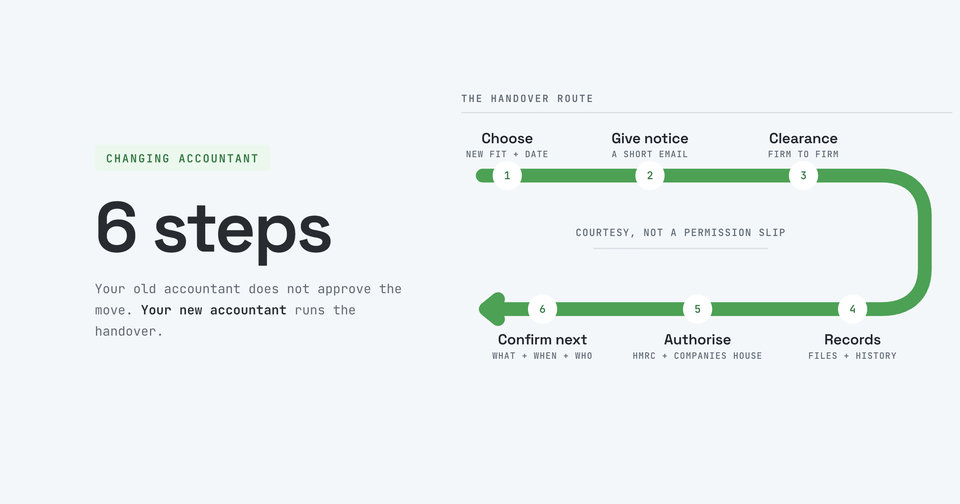
1. Choose your new accountant and agree a start date. Have a first conversation about your business, your filing history, and what you need going forward. A short call is usually enough to check the fit before anything formal begins.
2. Give notice to your current accountant. A short email is enough. You do not owe a long explanation, though a polite one is good manners. Confirm the date you want the relationship to end, ideally just after your next filing deadline rather than mid-task.
3. Your new accountant requests professional clearance. This is a formal letter or email between the two firms. You do not need to chase it yourself, because your new accountant handles it directly on your behalf.
4. Records are transferred. Your old accountant should hand over your accounting records, prior year accounts and tax computations, so your new accountant can continue without gaps. Working papers created during that work remain the outgoing accountant's own property. Professional clearance is about passing on the handover information your new accountant needs, not those files themselves. If your bookkeeping lives in cloud software such as QuickBooks, this step can be as simple as adding your new accountant as a user.
5. HMRC and Companies House details are updated. Your new accountant needs authorisation as your agent with HMRC for the relevant taxes. Companies House access is arranged where they will be filing on your behalf, such as being added as a presenter. This part is administrative, and your new accountant will normally lead it.
6. Your new accountant confirms what happens next. A good handover ends with clarity about what is due, when, and who owns it. You should never be left unsure what has already been filed and what is still outstanding.
When is the best time to switch?
There is no rule against switching mid-year, but timing does affect how smooth it feels. The cleanest moment is right after a year-end or a VAT quarter has been filed, so nothing is left half-finished between two firms. Switching mid-return is possible, but it adds a layer of coordination that a clean break avoids.
If a deadline is close and your current accountant has gone quiet, do not wait for the perfect moment. A responsive new accountant can often pick up an urgent filing faster than a slow one can be chased for another month.
What if your old accountant is difficult about it?
Most handovers are polite and uneventful. Occasionally, though, an old accountant drags their feet on releasing records. You are still entitled to your own underlying financial data, since it belongs to your business, not to the firm that prepared it. If a handover stalls, your new accountant can usually request the records directly. They can also escalate through the relevant professional body if a firm stays unreasonably unresponsive.
What to have ready before you start
Gather your Companies House login or authentication code, your UTR and VAT number if you have one, access to your accounting software, and copies of your last filed accounts and tax returns if you have them to hand. None of this is required before your first chat. But having it ready shortens the handover considerably once you begin.
Common questions about switching
Will switching affect a deadline that is due soon? Not if you plan the handover properly. Tell your new accountant about any upcoming deadline as early as you can, so they can confirm whether they can meet it or whether your old accountant should finish that one piece of work first.
Can sole traders switch as easily as limited companies? Yes. The process is simpler for sole traders, since there is no Companies House step, only HMRC authorisation and a transfer of your records.
Do I need to tell HMRC myself? No. Your new accountant submits the agent authorisation request through HMRC's own systems once you have confirmed you want them to act for you.
What happens to my old accountant's software access? Ask them to remove themselves as a user from your accounting software once the handover is complete, or remove them yourself if you manage that software directly. This closes the loop cleanly on both sides.
Making the move
Slow replies, rising fees, or outdated processes are common reasons to think about a change. The steps above are genuinely all there is to it. You owe no lengthy explanation, and there is no professional reason your current accountant can use to keep you in place against your wishes.
For a structured version of everything above, work through our switching accountants checklist at your own pace, ticking off each step as your handover progresses. When you are ready to talk, book a discovery call and we will walk through your current filing history, confirm what needs handling first, and agree a clean start date together.

Luke Raczynski
ACCA-regulated accountant. Lean Ledger prepares limited company accounts for UK founders who'd rather have year end be a 30-minute conversation than a three-week scramble.