How Much Does an Accountant Cost in the UK?
What actually drives accountant fees, typical UK market ranges, and how to compare quotes properly.

Founder, Lean Ledger Ltd
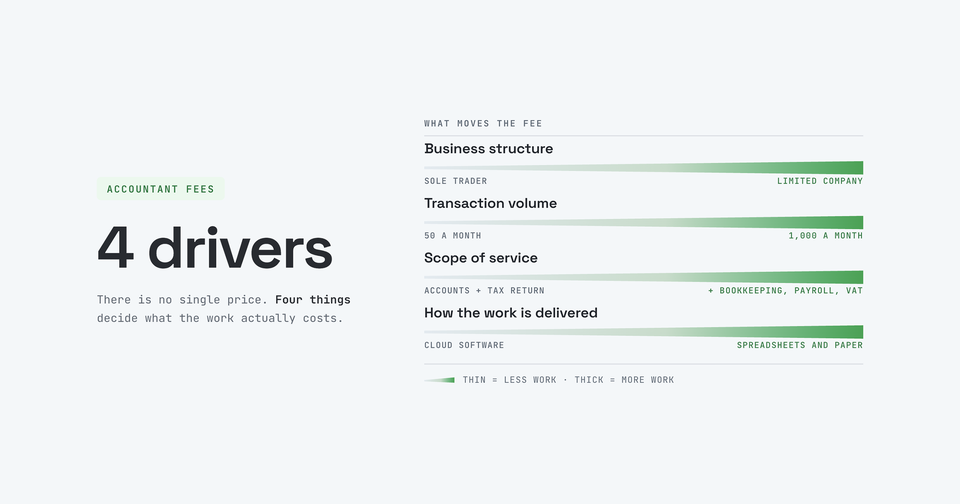
Accountant fees vary hugely by business type, turnover and scope of service. This guide breaks down what drives the cost and how to compare quotes so you know what you are actually paying for.
"What does an accountant cost?" is one of the hardest questions to answer honestly. The true answer is "it depends on what you actually need." That is not a dodge. Accountant fees in the UK vary a lot by business type, turnover, and the range of services included. A single headline number would mislead almost everyone who read it.
This guide breaks down what drives the cost, some indicative budgeting examples, and what tends to be included or excluded. For our own current pricing, see our pricing page, which sets out planning ranges for each service.
What actually drives the cost
Four things move the price more than anything else. Business structure matters first. A sole trader with simple income usually costs less to look after than a limited company, since a company has more legal filings to make each year. Transaction volume matters second. An accountant spends real time matching up bank transactions, invoices and receipts, and a business with a thousand transactions a month takes longer than one with fifty.
Scope of service is the third driver. A basic compliance package, covering annual accounts and a tax return, costs less than a fuller package that adds monthly bookkeeping, payroll, VAT returns and ongoing advice. The fourth driver is how the work gets delivered. Firms using modern cloud software can often work faster than firms still using spreadsheets and paper records. That efficiency sometimes shows up in the fee.
Indicative budgeting examples
These figures are illustrative budgeting estimates, not a published market survey or a quote from any specific firm. Actual fees vary by region, complexity and provider. As broad, general guidance only:
- Sole trader self assessment, straightforward income: often somewhere in the low hundreds of pounds per year.
- Simple limited company accounts and corporation tax return, low transaction volume: commonly in the low-to-mid hundreds through to around a thousand pounds per year.
- Fuller limited company package including monthly bookkeeping, payroll and VAT: often priced as a monthly retainer rather than an annual fee, scaling with the amount of work involved.
Treat these as a starting point for comparison, not a promise. The only way to know what your business will actually pay is to get a quote based on your specific numbers. You can see our own planning ranges on our pricing page.
What is usually included, and what is not
Basic compliance work is the baseline almost every accountant includes. That means the accounts and tax return every business must file to meet legal deadlines. Beyond that, inclusions vary a great deal. Some firms charge separately for bookkeeping, payroll, VAT returns and ad hoc advice. Others bundle these into one monthly fee.
Before comparing two quotes, check exactly what each one covers. A cheaper headline fee that excludes bookkeeping can end up costing more overall, once you add that work back in separately. Ask what happens if things change mid-year, such as registering for VAT or taking on your first employee. Some firms charge extra for scope changes, and others build in some flexibility.
Online accountants versus traditional high street firms
Online accountants typically run with lower running costs than firms that keep a physical office for client meetings. That difference can show up in the price. Working online also usually means faster turnaround, since records move through cloud software rather than physical paperwork. Communication happens by email, call or message, rather than requiring an in-person visit.
This does not automatically make online cheaper in every case. Pricing still depends mostly on the scope of work rather than the delivery model alone. But for founders who are happy working online, an online accountant is often a real option worth comparing against local firms. Our online accountant service explains how that model works in practice.
How to compare quotes properly
Ask each firm for a fixed quote based on your actual numbers, not a vague range. Confirm what is included, what counts as extra, and how often the fee gets reviewed. Ask how quickly they typically respond to questions, since slow replies are one of the most common reasons businesses end up switching later. Ask whether the fee is fixed for the year, or can move if your transaction volume changes partway through.
A slightly higher fee from a responsive, well-organised accountant is often better value than a lower fee from one who is hard to reach when a deadline is close. Price alone rarely tells you which is which.
Common questions about accountant costs
Is a cheaper accountant always a worse choice? Not necessarily. Some lower-cost accountants are simply more efficient, especially those built around cloud software rather than manual processes. What matters most is whether the price matches the scope of work you actually need done.
Do accountants charge for a first call? Many do not. A first call is usually free. It lets both sides check the fit is right before any fee is agreed.
Will my fee change every year? It can, especially if your turnover or transaction volume grows. A good accountant will tell you in advance rather than surprise you with an increase at renewal time.
Can I ask for a fixed fee instead of an hourly rate? Yes, and most accountants who work with small businesses now prefer fixed monthly or annual fees. A fixed fee gives you certainty and avoids the worry of a bill growing every time you ask a question.
Does a busier business always pay more? Usually, yes, but not always in a straight line. A tidy, well-organised set of records can cost less to process than a messy one with a similar turnover, since time spent chasing missing information adds to the work either way.
Is it worth paying more for a specialist in my sector? Sometimes. An accountant who already knows your industry may spot allowable expenses faster than one who does not, which can offset a higher fee over time. It is a fair question to ask any firm before you sign up.
Hidden costs to watch for
A few extra costs catch people out. Software subscriptions, such as QuickBooks, are sometimes included in the fee and sometimes charged on top, so ask which applies before you agree a price. Late or missing paperwork can also trigger extra charges, since it forces the accountant to spend more time chasing you rather than doing the work itself. Filing corrections after a deadline has passed usually cost more too, which is another good reason to send records on time.
None of this is a trick. It is simply the cost of extra work, and a clear firm will tell you about it upfront rather than adding it to a bill with no warning. Ask about these points directly during your first conversation, so nothing arrives as a surprise later on.
Getting an accurate quote for your business
Broad ranges are useful for a first sense of the market, but the number that actually matters is the one based on your own business. If you would like an exact quote rather than a general estimate, our pricing page sets out planning ranges for each service. Our online accountant service page explains how the online model works day to day. Both are a better next step than guessing from an average.
Lean Ledger pricing examples
For a concrete comparison, these are Lean Ledger’s current published starting fees for the services listed.
| Service | Starting fee / billing basis | Typical scope |
|---|---|---|
| Accounting | From GBP 150 / month | Annual accounts, Companies House filing support, deadline tracking and basic records review. |
| Bookkeeping | From GBP 120 / month | Bank feed review, transaction coding, reconciliations and monthly bookkeeping hygiene. |
| Tax | From GBP 350 | Tax return preparation, submission support, liability summary and deadline reminders. |
| VAT | From GBP 180 / quarter | VAT review, return preparation, MTD submission support and query follow-up. |
| Company Compliance | From GBP 250 / year | Confirmation statement support, statutory record checks and key filing reminders. |
| Making Tax Digital for Self Assessment | From GBP 45 / month | Quarterly update support, digital records review, software checks and filing reminders. |
| Business Advisory | From GBP 450 / session | Discovery, analysis, recommendations and a practical action summary. |
| Workflow Design | From GBP 750 / project | Process review, workflow map, software recommendations and implementation plan. |
| Fractional FD | From GBP 900 / month | Monthly finance review, management reporting, cash flow focus and decision support. |
| New Business Setup | From GBP 350 | Entity setup guidance, HMRC registrations, software setup advice and first-deadline checklist. |
These starting fees are planning figures. The final quote depends on your records, deadlines and agreed scope; services are not automatically bundled together.
Lean Ledger is not VAT-registered and does not charge VAT.
Source: Lean Ledger’s service pricing.

Luke Raczynski
ACCA-regulated accountant. Lean Ledger prepares limited company accounts for UK founders who'd rather have year end be a 30-minute conversation than a three-week scramble.