Tax 9 min read

Corporation Tax Calculator UK: How Much Will Your Company Pay in 2026/27?

The 19% and 25% rates, marginal relief, and the traps that make your bill bigger than expected.

flat vector avatar of Luke

By Luke Raczynski

Founder, Lean Ledger Ltd

ct_bands
Executive Summary

UK Corporation Tax for 2026/27 explained: the 19% small profits rate, the 25% main rate, marginal relief between £50,000 and £250,000, the 26.5% marginal rate nobody mentions, and the associated companies trap.

Start with the number itself: our free Corporation Tax calculator works out your 2026/27 bill, including marginal relief, short accounting periods and associated companies. Then come back here, because what follows is what the number means: why the rate isn't a single number, and the three things that most often make a company's bill higher than the director expected.

The short answer

For the 2026/27 tax year:

Taxable profit Rate
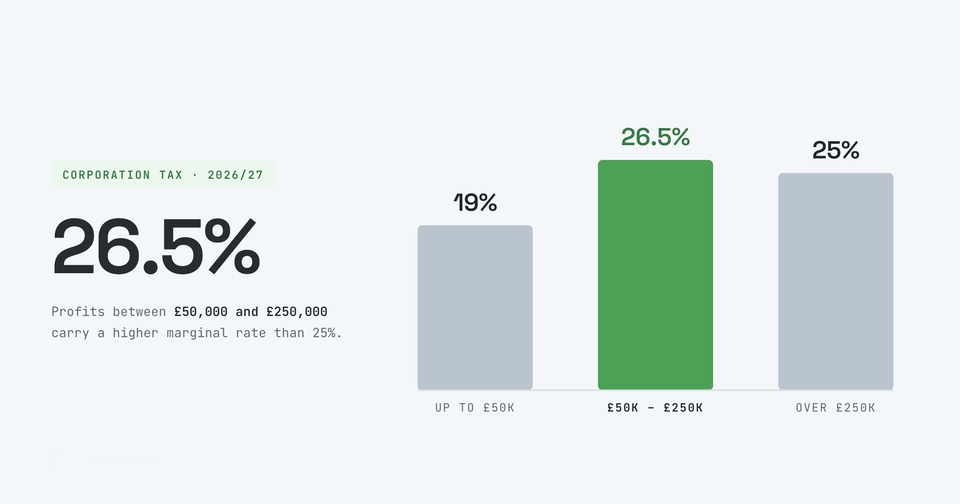
Up to £50,000 19% (small profits rate)
£50,001 to £250,000 25% less marginal relief, an effective rate rising from 19% to 25%
Over £250,000 25% (main rate)

These rates and thresholds have been unchanged since April 2023, and nothing announced for 2026/27 changes them.

Why there are two rates and a middle band

Between 2015 and 2023, Corporation Tax was a single flat rate. Every company paid the same percentage. Simple, and easy to calculate on the back of an envelope.

From April 2023 the UK went back to a two-rate system, with a taper between them. The logic is that a company making £30,000 and a company making £3 million shouldn't face the same rate, but you also can't have a cliff edge at £50,000 where earning one pound more costs you thousands. So the middle band exists to smooth the transition.

The mechanism used to smooth it is called marginal relief, and it's the part that catches people out.

How marginal relief actually works

If your profits fall between £50,000 and £250,000, you start at the 25% main rate and subtract a relief:

Marginal relief = 3/200 × (£250,000 − augmented profits) × (taxable profits ÷ augmented profits)

For most owner-managed companies, taxable profits and augmented profits are the same figure, so the last fraction is 1 and it simplifies to:

Marginal relief = 0.015 × (£250,000 − profits)

(Augmented profits are your taxable profits plus certain dividends received from companies you don't control. If your company doesn't hold shares in other companies, ignore this.)

Worked examples

Profit of £40,000

Below the lower limit, so the small profits rate applies straight through.

  • Tax: £40,000 × 19% = £7,600
  • Effective rate: 19.00%

Profit of £100,000

  • Start at the main rate: £100,000 × 25% = £25,000
  • Marginal relief: 0.015 × (£250,000 − £100,000) = £2,250
  • Tax: £25,000 − £2,250 = £22,750
  • Effective rate: 22.75%

Profit of £200,000

  • Start at the main rate: £200,000 × 25% = £50,000
  • Marginal relief: 0.015 × (£250,000 − £200,000) = £750
  • Tax: £50,000 − £750 = £49,250
  • Effective rate: 24.63%

Profit of £300,000

Above the upper limit, so the main rate applies to everything. There's no banding here, and this is the point people most often get wrong: it is not 19% on the first £50,000 and 25% on the rest.

  • Tax: £300,000 × 25% = £75,000
  • Effective rate: 25.00%

The 26.5% rate nobody mentions

Here's the number that matters more than either headline rate.

Your effective rate in the marginal band rises smoothly from 19% to 25%. But your marginal rate, the tax on the next pound of profit you earn, is 26.5% across the whole band.

Test it. Take a company at £100,000 profit paying £22,750. Add £10,000 of profit:

  • Tax at £110,000: (£110,000 × 25%) − (0.015 × £140,000) = £27,500 − £2,100 = £25,400
  • Extra tax on that £10,000: £25,400 − £22,750 = £2,650, which is 26.5%

So a company sitting anywhere in the £50k to £250k band pays 26.5% on every additional pound of profit, a higher marginal rate than the largest companies in the country pay. That's the arithmetic consequence of tapering a relief away, and it's the single most useful thing to know when you're deciding whether to bring a cost forward, buy equipment before year end, or make a pension contribution.

An analogy: marginal relief is a discount voucher that shrinks as you spend more. Between £50k and £250k you're not just paying tax on the extra profit, you're also losing a slice of the discount, so the real cost of that extra profit is higher than the headline rate suggests.

Associated companies: the trap

The £50,000 and £250,000 thresholds are divided by the number of associated companies, including the company itself.

Companies in the group Lower limit Upper limit
1 £50,000 £250,000
2 £25,000 £125,000
3 £16,667 £83,333
4 £12,500 £62,500

Two companies each making £30,000 don't both get the 19% rate. With the limits halved to £25,000, both are in the marginal band.

A company is generally associated with another if one controls the other, or both are under the control of the same person or group of persons. Control means more than 50% of share capital, voting power, or entitlement to assets on a winding up. Rights of associates, meaning spouses, civil partners, close relatives and business partners, can be attributed to you where there is substantial commercial interdependence between the companies.

Where this bites in practice: the founder with a trading company and a separate property company. Two ventures that were kept separate for perfectly good commercial reasons. A spouse's company that shares premises, staff or funding with yours. Dormant companies are excluded, but a company that's genuinely trading, even at a small scale, is not.

If you control more than one company, put the number into the calculator. The result usually surprises people.

Short accounting periods

The thresholds are also pro-rated for accounting periods shorter than 12 months. A six-month period has a lower limit of £25,000 and an upper limit of £125,000.

This most often shows up in a company's first accounting period. Companies House sets your first accounting reference date at the end of the month of your first anniversary, which usually produces a period longer than 12 months, and a Corporation Tax period cannot exceed 12 months. So the first period gets split into a 12-month period and a short stub, each with its own return and its own pro-rated thresholds.

When you have to pay, and when you have to file

These are two different dates, and the payment comes first.

Obligation Deadline 31 March year end example
Pay Corporation Tax 9 months and 1 day after period end 1 January
File the CT600 return 12 months after period end 31 March

You have to calculate and pay the tax three months before you're required to file the paperwork showing the calculation. Interest runs from the day after the payment deadline. This is why "I'll sort the accounts out closer to the filing deadline" is expensive advice.

Companies with taxable profits over £1.5 million pay in quarterly instalments instead, and over £20 million the instalment schedule accelerates further.

Why your bill is bigger than you calculated

The calculator works from taxable profit, not accounting profit. They are different numbers, and the gap is where most surprises live.

Costs that get added back:

  • Client entertaining. Never deductible, no matter how commercial. Staff entertaining is different and has its own rules.
  • Depreciation. Your accounts spread the cost of assets over their useful life. HMRC ignores that entirely and gives capital allowances instead.
  • Fines and penalties. Parking tickets, late filing penalties, regulatory fines. Not deductible.
  • Capital costs booked as expenses. Anything that improves rather than repairs an asset.
  • Legal fees on capital transactions, for example acquiring a property or a business.

Reliefs that come off:

  • Annual Investment Allowance, giving 100% relief on qualifying plant and machinery up to £1 million
  • Full expensing on qualifying new plant and machinery for companies
  • R&D relief, if you qualify
  • Losses brought forward or carried back
  • Employer pension contributions, deductible in the period paid, which is a genuinely useful lever in the marginal band

A company showing £48,000 profit in its accounts can easily have £55,000 of taxable profit once entertaining and depreciation are added back. That pushes it from a clean 19% into the marginal band, and every further pound costs 26.5%. Knowing this in month ten, when you can still act, is worth considerably more than discovering it in month eighteen.

Three levers worth knowing about

If your profits are near a threshold and you're still inside the accounting period, these are the ones that move the number:

  1. Employer pension contributions. Deductible in the period paid, no NI, and the contribution goes to you rather than HMRC. In the 26.5% marginal band this is the most efficient lever most owner-managed companies have.
  2. Timing of capital purchases. Equipment bought before year end can attract full relief in this period rather than the next. Buying things you don't need to save tax is still a bad idea, but bringing forward a purchase you'd make anyway is not.
  3. Genuine costs sitting in the wrong period. Accruals for work done but not yet invoiced by suppliers belong in the year the work happened. This is accounting accuracy, not planning, but it's often overlooked.

What none of these are is a scheme. They're the ordinary use of reliefs that exist precisely so that companies invest and directors save for retirement.

Frequently asked

Does the 19% rate apply to the first £50,000 of a larger company's profits?

No. Above £250,000 the 25% main rate applies to all profits. There is no banding in the sense income tax has bands.

Do I pay Corporation Tax on turnover?

No, on taxable profit. Turnover less allowable costs, then adjusted for tax purposes.

Do dividends I pay reduce my Corporation Tax?

No. Dividends are a distribution of profit after tax. Salary and employer pension contributions are deductible, dividends are not. This is the fundamental trade-off in profit extraction planning.

What if my company made a loss?

No Corporation Tax is due, and losses can generally be carried forward against future profits or, in some circumstances, carried back against the previous year's profits to generate a refund. You still have to file a CT600.

What if my company is dormant?

No Corporation Tax, but you may still need to file. Tell HMRC the company is dormant, and file dormant accounts at Companies House.

Lean Ledger works with UK limited company directors on the version of this question that actually matters: not just what the bill is, but whether it needed to be that size. If you're in the marginal band, near a threshold, or unsure whether you have associated companies, that's a 20-minute conversation.

Book a discovery call →

Rates and thresholds shown are for the 2026/27 tax year, verified August 2026. General information, not advice for your circumstances.