How to Prepare Limited Company Accounts: A Step-by-Step Guide for UK Directors
A practical workflow for preparing, reviewing and filing UK limited company accounts.

Founder, Lean Ledger Ltd
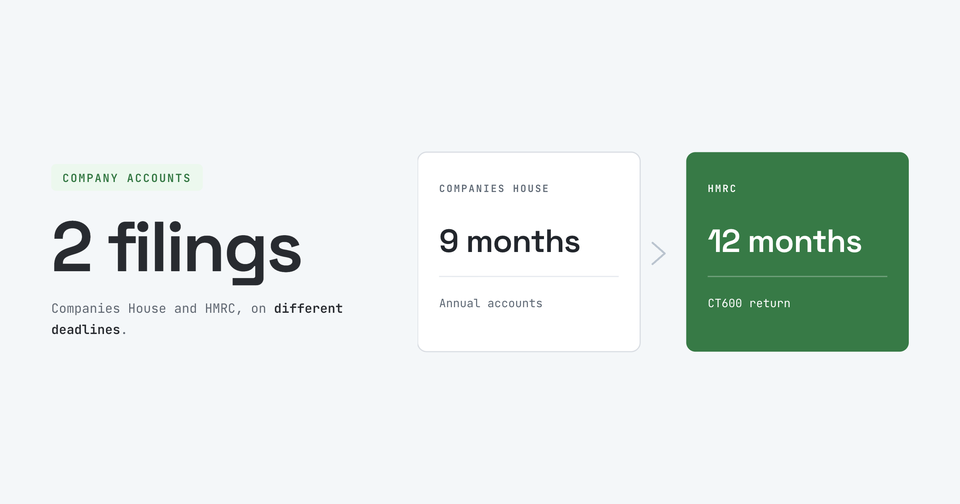
A practical, step-by-step guide to preparing UK limited company accounts: the records you need, building a trial balance, choosing FRS 105 or FRS 102 1A, accruals and prepayments, and filing with Companies House and HMRC.
Every UK limited company has to prepare annual accounts. Not "should", not "if it's a good idea". The Companies Act puts the duty on you as a director personally, and it doesn't matter whether your company turned over £2m or nothing at all.
Most guides on this topic stop at "hire an accountant". That's fine advice, but it doesn't tell you what actually happens between your bank statements and a filed set of accounts. This guide does. Whether you end up doing it yourself or handing it over, you should understand the workflow, because you're the one signing it off.
What "annual accounts" actually means
Your annual accounts (also called statutory accounts or year end accounts) are a formal record of your company's financial position for the year. For a typical small or micro company they include:
- A balance sheet, showing what the company owns and owes on the last day of the financial year
- A profit and loss account, showing income and expenditure across the year
- Notes to the accounts, explaining the numbers
- A director's statement on the balance sheet confirming the accounts were approved
Those accounts then go to two different places, in two different formats, for two different purposes:
- Companies House gets a version for the public register
- HMRC gets the full accounts plus a Corporation Tax return (CT600) and a tax computation
They are separate filings with separate deadlines, and one of the most common director mistakes is assuming that filing at Companies House also deals with HMRC. It doesn't.
Step 1: Gather your records
You cannot prepare accounts from memory, and you cannot prepare them from a bank feed alone. You need the underlying documents. At minimum:
Bank and money
- Bank statements covering the full financial year, for every business account
- Credit card statements
- Any loan or finance agreements, with the original schedule
- Petty cash records, if you use cash at all
Income
- Every sales invoice you raised, in sequence
- Records of any income that didn't come through an invoice (interest, grants, refunds)
- A list of invoices still unpaid at year end (your debtors)
Costs
- Purchase invoices and receipts, matched to bank payments
- A list of supplier invoices you'd received but not yet paid at year end (your creditors)
- Details of anything bought that will last more than a year, for example equipment, computers, vehicles (these are fixed assets, not day-to-day costs)
Payroll and directors
- Payroll reports for the year, if you run PAYE
- A record of every transaction between you and the company personally: money you put in, money you took out, expenses you paid personally
Other
- VAT returns for the year, if registered
- Stock count at the year end date, if you hold stock
- Details of any dividends declared, with board minutes and dividend vouchers
That last category matters more than founders expect. If you've taken money out of the company without a payslip or a properly declared dividend, it's a director's loan, and director's loans have their own tax consequences.
The realistic version of this step: if your bookkeeping is up to date throughout the year, gathering records takes an afternoon. If it isn't, this step is the whole job, and it's why year end feels painful. Fix the bookkeeping and year end stops being an event.
Step 2: Reconcile everything
Reconciliation means proving that your records agree with an independent source. It's the step most likely to be skipped and most likely to cause problems.
Bank reconciliation. Your accounting records should show the same closing balance as the bank statement on the last day of the year. If they don't, something is missing, duplicated, or misposted. Chase the difference until it's zero. "Close enough" is not a reconciliation.
VAT reconciliation. The VAT you've filed across the year's returns should agree to the VAT control account in your books. A gap here usually means a return was filed from figures that were later changed.
Debtors and creditors. Your list of unpaid sales invoices should tie to the debtors balance. Same for unpaid purchase invoices and creditors. Old items sitting on these lists that will never be paid need to be written off, not carried forward forever.
Director's loan account. Total up everything you put in and everything you took out. Know whether the company owes you or you owe the company at the year end date. Get this wrong and you can trigger a section 455 tax charge without realising it.
Step 3: Build the trial balance
Once everything is reconciled, you produce a trial balance: a list of every account in your books with its closing debit or credit balance, where total debits equal total credits.
If you use accounting software, this is a report you run rather than something you build by hand. But you still need to read it critically, and there are two questions worth asking of every line:
- 1. Does this balance make sense? A negative bank balance on an account that's never overdrawn, a suspense account with £4,000 in it, a supplier balance that's been sitting unchanged for three years. These are all signals.
- 2. Is this in the right place? Software guesses at coding, and it guesses badly on anything unusual. Equipment purchases coded to office costs. Loan repayments treated as expenses when only the interest is deductible. Personal spending sitting in the P&L.
The trial balance is where you catch these. Everything downstream depends on it being right.
Step 4: Post the year end adjustments
This is where bookkeeping becomes accounting. Your books record what moved through the bank. Accounts have to record what actually belongs to the year, which is not the same thing.
Accruals. Costs you've incurred but not yet been billed for. Your December electricity bill arrives in January, but the electricity was used in December, so it belongs in the year that just ended. Same for accountancy fees for the year's accounts, the last month of a service you're billed in arrears, or unpaid interest.
Prepayments. The mirror image. Costs you've paid that relate to the next year. Annual insurance paid in November covering to the following October, software subscriptions, rent paid quarterly in advance. Only the portion relating to this year goes in this year's P&L.
Here's the analogy that makes accruals and prepayments click: think of your financial year as a room with a door at each end. Accruals and prepayments are you standing at the doors, deciding which costs are allowed inside based on when the value was consumed, not when the money moved.
Depreciation. If you bought a £3,000 laptop that will last three years, charging the whole £3,000 to one year distorts that year's profit. Depreciation spreads the cost across the asset's useful life. Note that depreciation is not tax deductible; HMRC gives you capital allowances instead, which is a separate calculation in the tax computation.
Stock. If you hold stock, the closing stock figure from your year end count moves out of cost of sales and onto the balance sheet. Stock should be valued at the lower of cost and net realisable value, meaning you can't value damaged or unsellable stock at what you paid for it.
Dividends. Dividends are a distribution of post-tax profit, not a business expense. They reduce reserves on the balance sheet, they never touch the P&L. And they can only be paid out of distributable reserves, which means accumulated post-tax profits. Paying a dividend when the reserves aren't there makes it unlawful, and it usually gets reclassified as a director's loan or salary, with tax consequences attached.
Corporation Tax. Once profit is settled, calculate the tax and post it as both a charge in the P&L and a liability on the balance sheet.
Step 5: Choose your reporting framework
Small UK companies have a choice, and it's worth understanding rather than accepting whatever your software defaults to.
The size thresholds
For accounting periods beginning on or after 6 April 2025, thresholds were raised substantially. You qualify for a size category by meeting two of the three tests:
| Micro-entity | Small | |
|---|---|---|
| Turnover | ≤ £1 million | ≤ £15 million |
| Balance sheet total | ≤ £500,000 | ≤ £7.5 million |
| Average employees | ≤ 10 | ≤ 50 |
The uplift moved a lot of companies down a category. If you were preparing FRS 102 1A accounts a couple of years ago on the basis of the old £632k micro turnover limit, you may now qualify as a micro-entity.
FRS 105 (the micro-entities regime)
The stripped-back option. Highly simplified formats, a very short set of notes, and no requirement for a directors' report.
Suits you if: you're a straightforward owner-managed company, nobody outside the company relies on the accounts, and you want the least work and the least on the public record.
The trade-offs: FRS 105 doesn't allow revaluation of assets, doesn't recognise deferred tax, and gives a genuinely minimal picture. If a bank, an investor, or a prospective buyer reads your accounts, minimal can read as opaque. There's also no fair value accounting for investment property, which matters if you hold any.
FRS 102 Section 1A (small entities)
More detail, more disclosure, more work, and a set of accounts that actually tells a story.
Suits you if: you're raising finance, you have external shareholders, you're building towards a sale, or you hold assets where the FRS 105 restrictions bite.
The practical point most guides miss: this choice isn't purely technical. Your filed accounts are public. Anyone can look them up. Suppliers run credit checks on them, prospective clients occasionally look, and acquirers definitely do. If your company's credibility matters commercially, the framework that shows more can be worth the extra cost.
Two changes to plan for:
- Software-only filing from 1 April 2027. Companies House is withdrawing the web and paper filing routes for all accounts, including dormant accounts. Every company will need commercial software to file. This bites earliest for companies with year ends from around 31 July 2026 onwards.
- Profit and loss on the public record from April 2028. Under the Economic Crime and Corporate Transparency Act, small and micro companies will have to file a profit and loss account at Companies House, ending the practice of filing balance-sheet-only accounts. If you chose a framework specifically to keep turnover and profit off the public register, that option has an expiry date.
Step 6: File with Companies House
Deadline: 9 months after your accounting reference date, for a private limited company. First accounts after incorporation are different: 21 months from the date of incorporation.
Penalties are automatic. No reasonable excuse required for them to apply, and Companies House applies them without discretion in most cases:
| How late | Penalty |
|---|---|
| Up to 1 month | £150 |
| 1 to 3 months | £375 |
| 3 to 6 months | £750 |
| More than 6 months | £1,500 |
File late in two consecutive financial years and the penalty is doubled. Persistent failure to file is a criminal offence for which directors can be prosecuted and disqualified, and Companies House has been noticeably more willing to pursue this recently.
Practical point: don't file on the deadline. Companies House processing has had delays, and a filing that arrives on time but processes late can still generate a penalty notice. Build in a fortnight of buffer.
Step 7: File with HMRC
Two separate obligations, two separate dates, and they're both different from the Companies House one.
Pay your Corporation Tax: 9 months and 1 day after the end of your accounting period. Note this is before the return is due. You have to work out and pay the tax before you're required to file the paperwork that shows the calculation. Interest runs from the day after the due date.
File your CT600 return: 12 months after the end of your accounting period. This goes online with the accounts and tax computation attached, both tagged in iXBRL.
Late filing penalties for the CT600 start at £100, another £100 at three months, then 10% of the unpaid tax at six months and a further 10% at twelve. File late three times in a row and the £100 penalties become £500 each.
The tax computation is not just your accounting profit. It starts from accounting profit, then adjusts:
- Add back disallowable costs (client entertaining, most fines and penalties, depreciation)
- Deduct capital allowances in place of depreciation, including the Annual Investment Allowance and full expensing where it applies
- Adjust for any losses brought forward or carried back
- Deduct qualifying relief such as R&D, if you're eligible
The gap between accounting profit and taxable profit surprises founders. A company can show a £40,000 profit in its accounts and have taxable profits of £52,000 once entertaining and depreciation are added back. That difference matters when your profits are near the £50,000 Corporation Tax threshold.
The deadline summary
For a company with a 31 March year end:
| Task | Deadline | Date |
|---|---|---|
| Pay Corporation Tax | 9 months + 1 day | 1 January |
| File accounts at Companies House | 9 months | 31 December |
| File CT600 at HMRC | 12 months | 31 March |
| Confirmation statement | Annually, on its own cycle | Varies |
The confirmation statement is separate from your accounts entirely. It confirms your registered details, and it has its own annual date that has nothing to do with your year end. It's the filing directors forget most often.
Where directors most often go wrong
Treating the bank balance as profit. Your bank balance includes money you owe in VAT, PAYE, and Corporation Tax. Profit and cash are different questions.
Undocumented director withdrawals. Money out without a payslip, a dividend voucher, or an expense claim is a director's loan. Owe the company more than £10,000 at any point and there's a benefit in kind. Leave it outstanding more than nine months and a day after year end and there's a section 455 charge, refundable only once the loan is repaid. That rate rose from 33.75% to 35.75% for loans made on or after 6 April 2026, tracking the dividend upper rate. Loans made before that date generally keep the old rate, and because repayments are matched against the oldest borrowing first, a loan account that straddles April 2026 can leave the expensive borrowing outstanding without anyone noticing.
Dividends without reserves. Declaring dividends from a company without accumulated post-tax profits makes them unlawful and reclassifiable.
Missing the HMRC filing entirely. Filing at Companies House feels like "doing your accounts". It's half of it.
Filing on the deadline. Buffer costs nothing. Penalties cost £150 upwards.
Leaving the whole thing to month nine. The single biggest driver of a bad year end isn't complexity, it's compression. Nine months of reconstruction in three weeks produces errors and eliminates any chance of tax planning, because by then every decision that could have changed the outcome has already been made.
Should you do this yourself?
You can. Nothing legally requires a limited company's accounts to be prepared by an accountant, and for a genuinely simple micro-entity with clean records and a single bank account, filing yourself is realistic.
It stops being realistic when: you have stock, you have fixed assets and need capital allowance planning, you have a director's loan, you have multiple income streams, you're near the £50,000 or £250,000 Corporation Tax thresholds, you're VAT registered on anything other than the simplest scheme, or you're anywhere near a decision about how to extract profit.
The honest framing is that accounts preparation has two halves. The compliance half, getting a correct set of accounts filed on time, is achievable alone if your records are tidy. The advisory half, the decisions that change how much tax you actually pay, is where an accountant either earns their fee several times over or doesn't. If your accountant only ever produces the first half, that's worth noticing.
Lean Ledger prepares limited company accounts for UK founders who'd rather have the year end be a 30-minute conversation than a three-week scramble. We work with clean, automated bookkeeping throughout the year, so year end is a review rather than a reconstruction.
This guide reflects UK rules as at August 2026 and the 2026/27 tax year. It's general information, not advice for your specific circumstances.

Luke Raczynski
ACCA-regulated accountant. Lean Ledger prepares limited company accounts for UK founders who'd rather have year end be a 30-minute conversation than a three-week scramble.