UK VAT: monitor your taxable turnover before the threshold monitors you

Founder, Lean Ledger Ltd
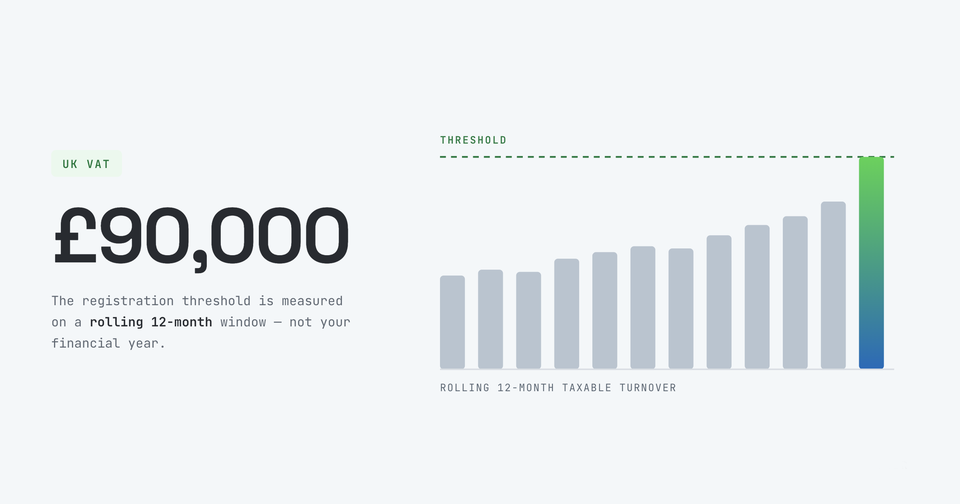
UK businesses should monitor taxable turnover every month, using both the rolling 12-month and 30-day forward tests. Crossing the £90,000 threshold can trigger compulsory VAT registration, so regular monitoring helps avoid late registration, unexpected VAT liabilities and penalties.
For UK-established businesses making supplies in the UK. Current as at 9 August 2026. General information, not tax advice. VAT treatment can be fact-specific.
VAT registration is not an annual “wait and see” decision. For most UK businesses it is a monitoring task that runs on a schedule. At the end of every month, look back at the last 12 months of taxable turnover, then look forward 30 days. Two checks, once a month, every month.
The compulsory registration threshold is taxable turnover of more than £90,000. Taxable turnover is not the same number as the revenue line in your management accounts. It is the value of supplies that are not exempt and not outside the scope of VAT. That means standard-rated, reduced-rated, and zero-rated sales all count, along with certain other items such as reverse charge supplies. Exempt and out-of-scope supplies are generally left out. HMRC: when to register
The two tests
The rolling 12-month test. If taxable turnover for the previous 12 months goes over £90,000, you apply within 30 days of the end of the month in which you crossed it. Registration normally takes effect from the first day of the second month after you exceed the threshold.
The 30-day future test. If you expect taxable turnover to go over £90,000 in the next 30 days, for instance, because you have just signed a significant contract, you apply by the end of those 30 days. Here the effective date is the day you realised you would exceed the threshold, not the day the cash lands. Register late and VAT plus a penalty can fall due from the correct effective date anyway. HMRC’s registration timing examples. The control is not complicated. Keep a rolling 12-month tracker, updated monthly. Classify every sale correctly for VAT as you go. Keep a 30-day forecast that includes signed contracts and work you can credibly bank on. Then set your internal alert below £90,000 rather than at it, so pricing, evidence and the registration itself can be handled calmly rather than retrospectively.
Exceptions are not loopholes
If the rolling 12-month total goes over £90,000 only temporarily, you can apply to HMRC for an exception from registration. You have to show that taxable supplies will not go over the £88,000 deregistration threshold in the next 12 months. It is an application; it needs HMRC’s approval, and it does not switch off monthly monitoring. HMRC: apply for an exception
That is a different thing from an exemption from registration. A business making only exempt or out-of-scope supplies does not have to register. Where most taxable supplies are zero rated, an exemption may also be available, but again HMRC’s permission is required. Worth repeating, because this is where people trip: zero-rated is not the same as exempt, and zero-rated sales still count towards taxable turnover. HMRC’s distinction
Registering before reaching the threshold
Voluntary VAT registration could be beneficial in certain scenarios. For example, if you want to reclaim input VAT, have mostly VAT-registered customers, or if you expect to reach the threshold soon anyway. The trade-off is real. You charge and account for VAT where applicable, you keep the records, you file the returns.
It is a commercial decision, not a badge of size. Model the effect on your margins, your customer pricing and your admin time before you opt in. HMRC’s registration impact tool
Coming back off the register
Registration is not permanent. You must cancel within 30 days if you stop trading or stop making taxable supplies, or if there are certain VAT group changes. You can ask HMRC to cancel if taxable turnover falls below £88,000.
Cancellation has consequences. You must stop charging VAT only from the official cancellation date. You must also submit a final VAT Return, keep VAT records for six years, and consider whether VAT is due on stock or assets where the conditions apply. HMRC: cancel your registration
One scope warning
Non-established taxable persons, and some Northern Ireland and EU situations, work under different rules. If that is you, do not rely on a short explainer like this one. HMRC’s current threshold supplement
If you would rather not track this by hand, that is fair enough. At Lean Ledger, we set up rolling 12-month VAT monitoring for UK limited companies and owner-managed businesses, so the threshold shows up in a report months before it shows up in a penalty. Get in touch if you want a second opinion on where you stand.

Luke Raczynski
ACCA-regulated accountant. Lean Ledger prepares limited company accounts for UK founders who'd rather have year end be a 30-minute conversation than a three-week scramble.